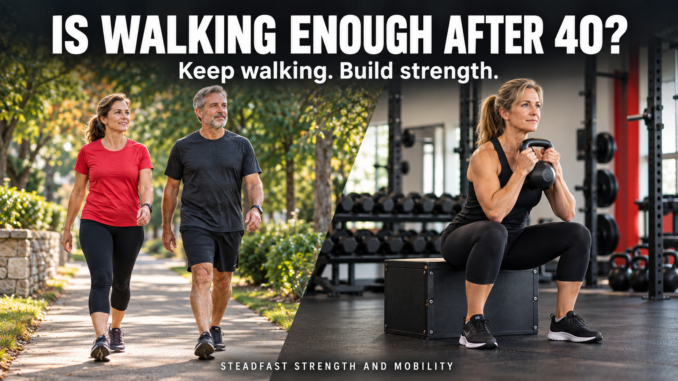
You walk the neighborhood. You take the stairs when you can. You get outside on the weekend. Your watch may even congratulate you on hitting your step goal.
Thank you for reading this post, don't forget to subscribe!
Then you carry something heavy upstairs, get up from the floor or try an exercise you have not done in years, and you wonder: Is walking enough after 40?
For busy adults in Fairfax and Haymarket, the challenge is often making those pieces fit into an already crowded week. A useful plan gives each activity a job and leaves you with something you can actually repeat.
What do you want walking to be enough for?
Before changing your routine, define the result you want. Being more active, walking farther and lifting a heavy box are different goals. The same activity will not prepare you equally for all three.
| Your goal | Where walking fits | What else to consider |
|---|---|---|
| Move more during the week | Short walks create convenient opportunities to be active. | Choose times and routes you can repeat. |
| Build aerobic fitness | Brisk walking can count toward aerobic activity recommendations. | Consider pace and total time, alongside your step count. |
| Get stronger for lifting and carrying | Walking keeps you moving but offers limited practice against heavier resistance. | Add appropriately challenging lifting, pushing and pulling exercises. |
| Feel more capable in varied movements | Walking practices one familiar movement repeatedly. | Practice the ranges and tasks your goals require, with suitable support. |
Your walking habit gives you something valuable to build on. If strength is missing from your week, the next step is to make room for it.
Walking and strength training have different jobs
The CDC recommends at least 150 minutes of moderate intensity aerobic activity each week for adults, plus muscle strengthening activity on at least two days. Strength work should cover the major muscle groups. These are separate parts of the recommendation.1
Brisk walking can count toward that aerobic target. A practical intensity check is the talk test: whether you can talk but would struggle to sing. A relaxed stroll still gets you moving, but it may not reach moderate intensity for you.2
Strength training asks your muscles to work against resistance. That resistance might come from a machine, a dumbbell, a band or your body weight. The exercise should require meaningful effort while allowing you to control the movement.
Think about the difference between walking to your car and lifting a suitcase into the trunk. Both involve movement, but the demands are different. If you want to improve the second task, your training needs an appropriate lifting challenge somewhere in the plan.
Walking up hills may make your walk more demanding. It still does not give your chest, back, shoulders and arms the same range of challenges as a balanced resistance program.
What do NASM and NSCA say?
The National Academy of Sports Medicine (NASM) describes functional strength training as developing strength for the movements people use in daily life. Its guidance emphasizes patterns such as squatting, hinging, pushing, pulling and carrying, with exercise choices tied to a person’s goals. This supports including resistance exercises that prepare you for tasks a walking routine does not fully train.3
The National Strength and Conditioning Association (NSCA), in its 2019 position statement on resistance training for older adults, identifies resistance exercise as an important tool for addressing age related losses in muscle mass, strength and physical function. It also emphasizes adapting programs to individual needs and capabilities.4
How that applies here: These sources support the value of strength training alongside other activity. They are not direct studies showing that walking is insufficient for every person over 40. NASM’s source is educational guidance, while NSCA’s source is a formal position statement focused on older adults. Our practical takeaway is to keep walking for aerobic activity and deliberately train the strength demands that matter to your life.
Does hitting 10,000 steps change the answer?
A step count is useful feedback about how much you walked. It does not tell you whether you practiced a squat, trained a pulling movement or gradually increased the resistance you can handle.
Use your step goal to support consistency. Use a separate training record to track strength. Write down the exercise, resistance, repetitions and how the movement felt. That record makes it easier to decide what to repeat or adjust next time.
You do not need to abandon a walking target that works for you. Just avoid asking that one number to describe your entire fitness routine.
A weekly plan that combines walking and strength
The following example combines 150 minutes of brisk walking with two strength sessions. It is an illustration of how the pieces can fit together, rather than a starting prescription for everyone. If your current activity is much lower, build toward a manageable routine gradually. Smaller amounts of activity still count.1
| Day | Walking | Strength |
|---|---|---|
| Monday | 15 minutes | Full body session |
| Tuesday | 30 minutes | — |
| Wednesday | 20 minutes | — |
| Thursday | 15 minutes | Full body session |
| Friday | 20 minutes | — |
| Saturday | 30 minutes | — |
| Sunday | 20 minutes | — |
Those walks can be broken into shorter outings. A walk before work and another after dinner may be easier to maintain than one longer block. Strength and walking also do not have to happen at the same time of day.
Start by putting the two strength appointments on your calendar. Then place your walking around the parts of the week where it already fits naturally. If a particular day keeps falling apart, change the arrangement before deciding you lack discipline. Our training adherence guide explains how to track consistency and adjust recurring barriers.
What should those strength sessions include?
A useful session covers several movement patterns without becoming a long collection of unrelated exercises. Exercise selection depends on your experience, available equipment and any relevant limitations.
Here are examples of patterns a coach might build around. This is a menu, not a requirement to perform every movement immediately.
| Pattern | Possible starting option | Coaching priority |
|---|---|---|
| Squat | Sit to stand from a stable chair | A height and amount of support you can control |
| Hinge | Practice a hip hinge before adding resistance | Learning the movement before making it heavier |
| Push | Wall pushup or suitable chest press | A comfortable setup and repeatable range |
| Pull | Supported row or suitable row machine | Controlled repetitions with an appropriate load |
| Carry or trunk control | A light carry or individually selected trunk exercise | Stable positioning and manageable effort |
Your first sessions should help you learn the setup and find a challenge you can repeat. Rest enough to perform the next set with control. Rushing through everything to keep your heart rate high can make it harder to focus on the strength skill you are practicing.
As an exercise becomes more manageable, progression might mean another repetition, slightly more resistance or less assistance. Change one variable at a time so you can judge the result. Our full body strength workout guide for adults over 40 goes deeper into building that foundation.
Where does mobility belong?
Start with the movements you need. Someone who struggles to get into a comfortable squat position may need a different approach from someone who has difficulty reaching overhead.
Choose a small amount of relevant movement practice before your strength work. Then use an exercise setup and range you can control. For some people, that means a higher chair. For others, it means a different grip, support or exercise altogether.
Mobility work should have a purpose you can explain. Ask whether it helps you get into the position or perform the task you are working on. You can explore this approach in our mobility training guide.
New or persistent pain calls for an appropriate assessment, rather than an assumption that you just need to stretch more. If a health condition or injury affects exercise, discuss suitable activity with your healthcare professional. Coaching can work within those recommendations; it does not replace medical care.
Make the first month repeatable
First, establish the routine
Choose realistic training times and a small set of suitable exercises. Keep notes on what you did. If you are returning after a long break, use our first 30 days back in the gym guide to think through the restart.
Next, improve consistency and execution
Repeat the movements long enough to learn them. Notice whether the setup is becoming easier to remember and the repetitions more consistent. A session does not need new exercises every week to remain useful.
Then, adjust the challenge
When you are completing the planned work with control and recovering adequately, consider a small progression. If a demanding workweek, poor sleep or unusual soreness makes the plan harder to manage, repeating or reducing the work may make more sense.
The calendar is a place to organize training. Your performance and recovery help determine how quickly to progress.
Choosing coaching in Fairfax or Haymarket
If you already walk regularly, tell a prospective coach that. Your existing habits should be part of the conversation, along with your goals, exercise history and weekly schedule.
Useful questions include:
- How will we decide which exercises fit my starting point?
- How will strength sessions fit around the activity I already do?
- What will we track to decide when to progress?
- How will the plan change when my schedule or recovery changes?
- What should I do independently between coached sessions?
At Steadfast Strength and Mobility, coaching begins with your goals, current ability and practical constraints. We use that information to shape exercise selection and progression, then adjust as your training develops.
Explore personal training in Fairfax or personal training in Haymarket to learn about the local options and discuss availability.
Common questions about walking after 40
Can I walk on strength training days?
Yes, walking and strength work can share a day. The amount and intensity should fit your current capacity. A long, demanding walk and a challenging leg session may require more adjustment than a short, comfortable walk.
Can I start strength training at home?
Yes. Body weight, bands and weights can all provide resistance.2 The important questions are whether the exercise fits you, whether your setup is secure and whether there is a sensible way to adjust the challenge as you improve.
Should I walk less to make time for lifting?
Look at your actual week. You may be able to add two short strength appointments without changing your walks. If time is tight, redistribute activity so both types of training have a place. Avoid removing a reliable habit before you have a workable replacement schedule.
What if I can manage only one strength session initially?
Use that session to establish a routine and learn suitable movements. Then look for a manageable way to work toward the recommended two days. A plan that starts within your capacity gives you something to build on.
Do I need to feel sore for strength training to work?
Delayed onset muscle soreness (DOMS) is not a useful target for planning progression. Track what you can perform with control, the resistance you use and how well you recover between sessions. Those details give you more actionable information than trying to make every workout leave you sore.
For planning easier days, explore active recovery and recovery capacity. These guides explain how to distinguish easy movement from another demanding workout and review your response before adding more training.
Keep your walks. Build the strength that complements them.
If you are in Fairfax or Haymarket and want help turning your current habits into a clear training plan, tell us where you are starting and what you want to do more confidently.
Sources
- CDC. Adult Activity: An Overview. Adult aerobic and muscle strengthening recommendations.
- CDC. What Counts as Physical Activity for Adults. Activity intensity and resistance exercise options.
- Cherry, H. National Academy of Sports Medicine. Functional Strength Training: Exercises Your Clients Will Actually Feel. August 28, 2026. Educational article on movement patterns and daily function.
- Fragala, M. S., et al. Resistance Training for Older Adults: Position Statement From the National Strength and Conditioning Association. Journal of Strength and Conditioning Research, 2019; 33(8):2019–2052. Publication record.
