

Walk into almost any supplement store and you will find shelves packed with products promising more muscle, faster recovery, increased energy, better testosterone levels, improved fat loss, stronger joints, and better overall performance.
Thank you for reading this post, don't forget to subscribe!
The marketing is usually impressive. The evidence is much less consistent.
Some supplements have legitimate uses and meaningful research behind them. Others may help only in very specific circumstances. Plenty are expensive solutions to problems that would be better addressed through training, nutrition, sleep, recovery, or medical care.
For adults over 40, that distinction matters even more. Strength training after 40 is not simply about chasing bigger numbers in the gym. Preserving muscle mass, strength, mobility, bone health, work capacity, and long term independence becomes increasingly important with age.
Supplements can occasionally support those goals. They are not the foundation.
Start with the problem you are trying to solve. Then decide whether a supplement is actually the right tool.
Do You Actually Need Supplements After 40?
Probably fewer than you think.
The word supplement tells you exactly what these products should do. They should supplement something that is already working reasonably well.
If your training has no progression, your sleep is inconsistent, your protein intake is inadequate, and your diet is mostly convenience food, adding six or seven supplements is unlikely to solve the underlying problem.
The National Institutes of Health Office of Dietary Supplements notes that performance supplements cannot substitute for a healthy diet, although some may have value depending on the person, activity, and goal.
Start with the fundamentals:
- Consistent resistance training
- Adequate protein and total calories
- Fruits, vegetables, and nutrient dense foods
- Adequate hydration
- Regular sleep
- Appropriate recovery
- A training plan that actually progresses
Then ask whether a particular supplement addresses a specific limitation.
Why Supplement Decisions Change After 40
Forty is not a biological cliff. You do not wake up on your 40th birthday suddenly unable to build muscle.
But the environment changes. Work and family demands can become heavier. Sleep can become less consistent. Old injuries accumulate. Daily activity often decreases. Recovery between hard sessions may require more attention. More adults also begin taking prescription medications or managing cardiovascular, metabolic, gastrointestinal, orthopedic, or other medical conditions.
At the same time, preserving skeletal muscle and strength becomes more important. Resistance training remains the primary intervention. Nutrition supports the adaptation. Supplements should be considered only after those pieces are addressed.
The useful question is not, “What supplements should I take?”
A better question is, “What is limiting my progress, and is there good evidence that a supplement can address it?”
Supplements With the Strongest Evidence
Creatine Monohydrate
Creatine is one of the most extensively studied sports supplements available. It helps increase phosphocreatine availability in muscle, which supports rapid ATP regeneration during short, high intensity efforts.
That can translate into better training capacity, strength, power, and repeated high intensity performance. For resistance training, creatine is one of the few supplements that consistently earns a serious look.
We already have a complete Steadfast article devoted to the subject, so there is no reason to duplicate it here.
Read our complete guide to creatine monohydrate.
Protein Powder
Protein powder is useful. That does not make it magical.
Whey, casein, soy, pea, egg, and blended protein powders primarily provide one thing: convenient dietary protein.
That convenience can matter. Someone who struggles to eat enough protein may find that a shake makes meeting a daily target much easier. Someone who already obtains enough high quality protein from food may gain little by adding more simply because it comes from a tub.
The NIH Office of Dietary Supplements notes that adequate protein supports muscle building, maintenance, repair, and recovery, and that protein supplements can help when food intake alone does not meet needs.
The practical rule is simple: use protein powder to close a protein gap, not because powder is superior to food.
Caffeine
Caffeine works. That is also why it deserves more respect than it sometimes receives.
Caffeine stimulates the central nervous system, can reduce perceived exertion and fatigue, and may improve endurance, strength, power, and repeated high intensity performance in some settings.
But more caffeine is not automatically better.
Potential problems include insomnia, restlessness, anxiety, nausea, increased heart rate, and poor recovery if caffeine disrupts sleep.
A pre workout containing caffeine is still caffeine. An energy drink containing caffeine is still caffeine. Coffee is still caffeine. If you stack several sources together, the total matters more than the branding on the container.
Beta Alanine
Beta alanine helps increase muscle carnosine, which contributes to buffering acidity during hard efforts. Its application is more specific than much of the marketing suggests.
It appears most relevant for repeated or sustained high intensity efforts lasting long enough for metabolic acidosis to become a limiting factor. That may matter for certain interval sessions, rowing, combat sports, circuits, or conditioning work.
For someone whose primary goal is basic strength training three days per week, beta alanine is usually not the first place to spend money.
A supplement can have evidence behind it and still be unnecessary for your specific goal.
Supplements That May Be Useful in the Right Situation
Vitamin D
Vitamin D is important for bone health and normal physiological function. Supplementation makes the most sense when dietary intake, sun exposure, or blood testing indicates a need.
Correcting a deficiency is very different from taking increasingly large doses “just in case.”
Omega 3 Fatty Acids
Omega 3 fatty acids may be useful when intake of fatty fish is low or when a person has a specific nutrition or health reason to increase intake. That does not mean every strength trainee automatically needs fish oil.
Electrolytes
Electrolyte products are aggressively marketed, but the need depends on actual fluid and electrolyte losses.
Long training sessions, significant heat exposure, high sweat rates, or prolonged endurance work can increase the usefulness of an electrolyte strategy. A short, moderate session in an air conditioned gym usually does not require an expensive hydration formula.
Match the intervention to the actual problem.
Magnesium
Magnesium participates in hundreds of physiological processes. That fact often gets turned into the claim that everyone should supplement it.
Those are not the same statement.
If dietary intake is inadequate or there is another specific reason for supplementation, magnesium may be useful. It should not automatically become part of every recovery stack.
Collagen and Gelatin
Collagen supplementation has become popular for joints, tendons, and connective tissue. Some research is promising in specific contexts, but collagen should not be confused with a complete protein source for maximizing muscle protein synthesis.
Think of it as a specialized tool, not a replacement for adequate total protein and progressive resistance training.
Popular Supplements That Are Often Overhyped
BCAAs
Branched chain amino acids were once treated as almost mandatory gym equipment.
The problem is that complete dietary protein already contains BCAAs. Whey contains them. Meat contains them. Eggs contain them. Dairy contains them. Many plant protein combinations contain them.
The NIH Office of Dietary Supplements states that studies have not consistently shown BCAA supplements improve exercise performance, build muscle mass, or improve recovery when compared with simply consuming adequate complete protein.
If total protein intake is already adequate, additional BCAAs are often redundant.
“Testosterone Boosters”
The phrase testosterone support does a lot of marketing work while promising surprisingly little.
Some nutrients can influence hormone status when correcting a deficiency. That is not the same as showing that an over the counter proprietary blend meaningfully increases muscle growth or corrects clinically low testosterone.
Persistent symptoms or suspected hormonal abnormalities deserve proper medical evaluation rather than guesswork with a supplement stack.
Fat Burners
Most fat burners rely heavily on stimulants or ingredients that produce small effects relative to the fundamentals of fat loss.
The major drivers remain energy balance, food intake, adherence, daily activity, and training.
A stimulant may temporarily increase energy expenditure or suppress appetite. That does not make it a substitute for a sustainable nutrition strategy.
Detox Products
Your liver and kidneys already perform detoxification functions. A product using the word “detox” on the front label does not automatically improve those processes.
This is one of the most abused marketing terms in the wellness industry.
Proprietary Muscle Building Blends
A product may advertise ten impressive ingredients while hiding the individual quantities inside a proprietary blend.
That makes it difficult to determine whether any ingredient is present at a useful dose.
Transparency matters. If you cannot tell how much of an ingredient you are taking, you cannot meaningfully compare the product with the doses used in research.
The Pros of Sports Supplements
Convenience
Protein powder is easier to consume than cooking another meal. Creatine takes seconds to add to a routine. Electrolytes can be practical during long or hot training sessions.
Convenience has value because convenience can improve adherence.
Correcting Specific Gaps
A supplement can be useful when it addresses an actual dietary shortfall, deficiency, or practical limitation.
Supporting Training Performance
Certain supplements, most notably creatine and caffeine, have enough evidence to justify consideration for appropriate goals and individuals.
Helping Meet Protein Requirements
For busy adults, protein powder can simplify nutrition. It does not outperform food simply because it is powdered, but it can make a difficult target easier to hit consistently.
The Cons of Sports Supplements
Cost
A supplement stack can quietly become a substantial monthly expense.
Ask whether that money would produce a larger return somewhere else: better groceries, coaching, a gym membership, physical therapy, better sleep habits, or simply a more consistent training routine.
Opportunity cost matters.
Ingredient Duplication
This is common. A pre workout contains caffeine. The energy drink contains caffeine. The fat burner contains caffeine. The person also drinks coffee.
The same duplication can happen with vitamins, minerals, herbs, and other active compounds.
Evaluate the entire stack, not one bottle at a time.
Drug and Supplement Interactions
Supplements contain biologically active compounds. They can interact with prescription medications, other supplements, and medical conditions.
Adults taking medications should discuss questionable combinations with a qualified physician or pharmacist rather than assuming that “natural” means harmless.
Contamination and Hidden Ingredients
This is one of the biggest blind spots in supplement use.
Dietary supplements are regulated differently from prescription drugs. Manufacturers generally do not have to prove effectiveness before a product reaches the market.
The National Center for Complementary and Integrative Health also warns that products marketed for bodybuilding, weight loss, and sexual enhancement have been found to contain undeclared prescription drugs, controlled substances, or other ingredients not listed on the label.
Research Does Not Always Match the Marketing
A study involving a small group of young, healthy, trained men does not automatically apply to every woman, every older adult, or every recreational lifter.
The NIH specifically notes that much sports supplement research has historically involved young healthy men, with less data in women, middle aged adults, older adults, and people with medical conditions.
How to Read a Supplement Label
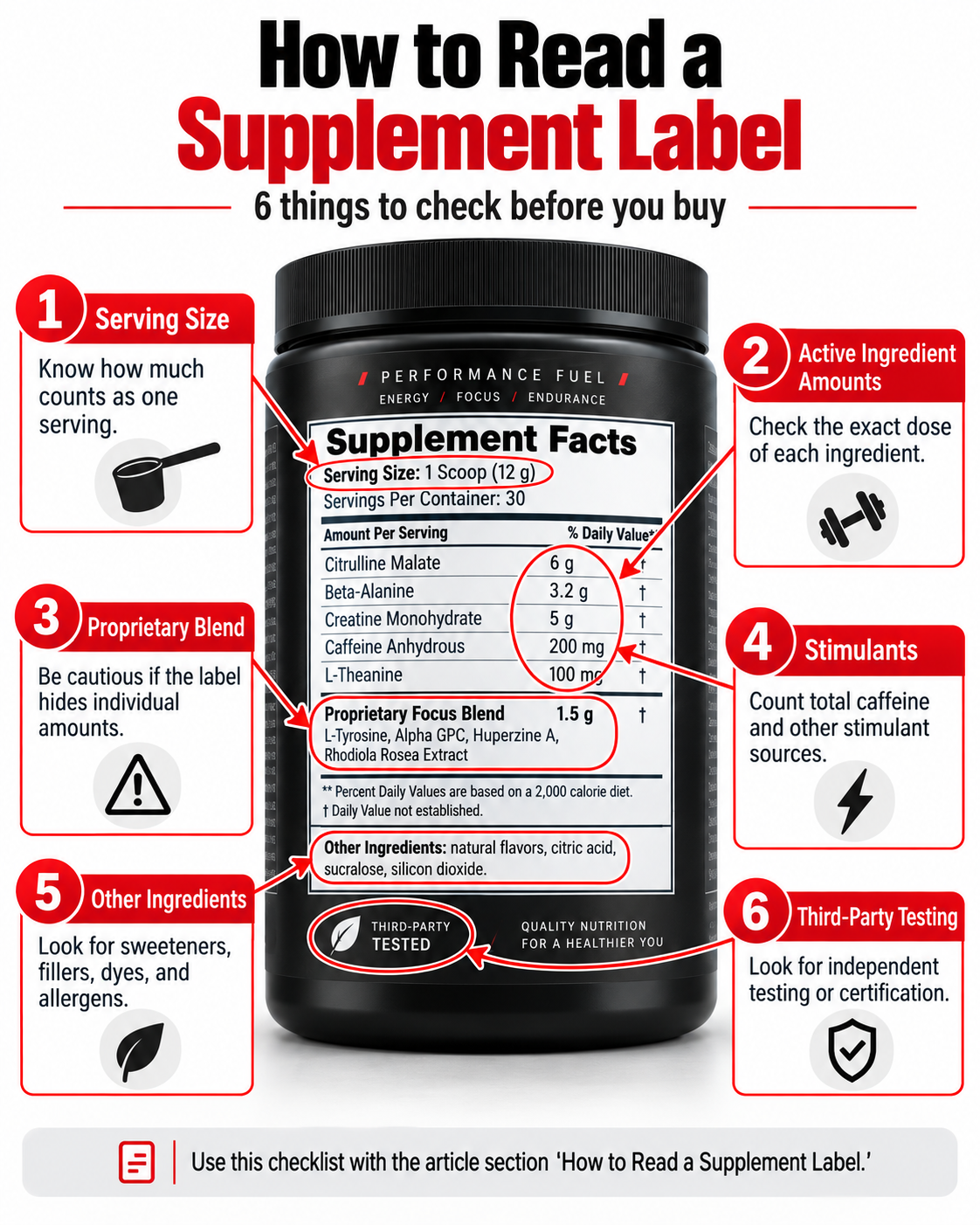
Look at the Actual Ingredient Amount
Do not stop at the ingredient name. Look at the dose.
A legitimate ingredient at a tiny dose is not the same product used in research.
Be Cautious With Proprietary Blends
If the label hides individual ingredient quantities, evaluating the product becomes much harder.
Look for Credible Third Party Testing
Independent testing can increase confidence that a product contains what the label says and that manufacturing quality has been checked. Common examples include NSF Certified for Sport, USP Verified, and other reputable independent testing programs.
Third party testing does not prove that a product works. It primarily helps answer a different question: is the product more likely to contain what it claims to contain?
Count Total Stimulants
Look beyond caffeine alone. Guarana, yerba mate, tea extracts, and other stimulant containing ingredients can contribute to the total effect.
Question Extreme Claims
Be skeptical of claims such as “melts fat,” “detoxifies the body,” “builds muscle without training,” or “clinically proven breakthrough formula.”
Marketing language is not evidence.
The Steadfast Supplement Checklist
Before buying a supplement, ask:
- What exact problem am I trying to solve?
- Can food, sleep, hydration, or better programming solve it?
- Is there good human research supporting the ingredient for my actual goal?
- Is the dose consistent with the research?
- Does the label disclose every ingredient and amount?
- Has the product been independently tested?
- Could it interact with medication, another supplement, or a medical condition?
- Am I already taking the same ingredient somewhere else?
- Am I buying convenience or a real physiological advantage?
- Would the money produce a larger return somewhere else?
Download the Steadfast Supplement Scorecard
Use our one page scorecard to evaluate a supplement by evidence, need, dose transparency, third party testing, interaction risk, cost, and whether the fundamentals can solve the same problem.
Download the Free Supplement Scorecard
You can also find it in our Forms & Free Downloads library.
Supplements Cannot Fix a Bad Training Program
This is the part supplement marketing rarely emphasizes.
You cannot supplement your way around poor training.
Muscle and strength are adaptations. They develop because the body repeatedly encounters a training stimulus that is challenging enough to require adaptation.
That usually means progressive overload, sufficient training volume, appropriate exercise selection, adequate recovery, and consistency.
- Creatine will not fix random workouts.
- Protein powder will not compensate for chronically inadequate nutrition.
- Caffeine will not replace sleep.
- Electrolytes will not fix poor hydration habits.
- A “testosterone booster” will not diagnose or treat a hormone disorder.
- A fat burner will not replace adherence to an appropriate calorie intake.
The supplement should support the program. The program should never depend on the supplement.
So, Which Supplements Should Someone Over 40 Actually Take?
There is no universal list.
For many healthy adults participating in resistance training, the conversation can start with a few basic questions:
- Are you eating enough protein?
- Would protein powder make that easier?
- Would creatine support your training goals?
- Do you already consume caffeine, and is additional caffeine actually necessary?
- Do your diet, blood work, medications, training environment, or medical history create a specific need?
Everything else should earn its place.
That approach is less exciting than buying twelve bottles. It is also much more rational.
Final Takeaway
Sports supplements exist on a spectrum.
Some have strong research behind them. Some may help in specific circumstances. Some provide convenience more than physiological advantage. Others are built primarily around marketing.
For adults over 40, the goal should not be to build the largest supplement stack possible.
The goal is to preserve muscle, improve strength, maintain physical capacity, recover well, and continue training consistently for decades.
Start with training. Start with nutrition. Start with sleep and recovery. Then use supplements selectively when they solve a real problem.
Frequently Asked Questions
Do I need supplements to build muscle after 40?
No. Resistance training, adequate energy intake, sufficient protein, and recovery remain the primary drivers. Supplements may support those fundamentals but do not replace them.
Is creatine worth taking after 40?
Creatine has substantial evidence supporting strength, power, and training capacity in appropriate users. Read our complete creatine guide for the full breakdown.
Do I need BCAAs if I already eat enough protein?
Usually not. Complete protein foods and high quality protein powders already supply BCAAs, and evidence for additional BCAA supplementation is inconsistent.
Are pre workouts safe after 40?
That depends on the ingredients, doses, stimulant content, medications, medical history, and individual tolerance. People with cardiovascular conditions, medication use, stimulant sensitivity, or other health concerns should review stimulant containing products with an appropriate healthcare professional.
Does protein powder build more muscle than food?
Protein powder primarily provides convenient protein. It can help someone meet a daily target but is not inherently superior to a well structured diet.
How can I tell whether a supplement is high quality?
Look for transparent ingredient amounts, credible third party testing, appropriate dosing, and manufacturers that avoid exaggerated claims.
Sources and Further Reading
- NIH Office of Dietary Supplements: Dietary Supplements for Exercise and Athletic Performance
- NIH Office of Dietary Supplements: Exercise and Athletic Performance, Consumer Fact Sheet
- NCCIH: Bodybuilding and Performance Enhancement Supplements
- NCCIH: Using Dietary Supplements Wisely
This article is for educational purposes and is not individualized medical advice. Supplement decisions can depend on medications, health conditions, pregnancy, surgery, diet, and laboratory findings. When those factors apply, review the product with a qualified physician or pharmacist.
