
A Steadfast guide to starting after 40, 5×5, GVT, 5/3/1, and the nine-week Russian routine
Give me five lifting programs and I can make a case for all five. Give me your actual calendar, training experience, and goal, and the conversation gets much more useful.
Because a program can look perfect on a spreadsheet and still be a terrible date. It wants four evenings you don’t have. It expects recovery you can’t give it. Or it asks you to test a heavy squat when you’re still figuring out where your feet belong.
So here’s how I’d size up five very different options: an over-40 beginner approach, 5×5, German Volume Training, Jim Wendler’s 5/3/1, and my favorite, the nine-week Russian squat, bench, and deadlift routine.
Yes, I have a favorite. No, that doesn’t make it the right starting point for everybody.
| Your schedule | Picture this: you can train on Tuesday and Saturday, but the plan needs four evenings. |
|---|---|
| The mismatch | That is a bad date before you even meet the barbell. |
| Important note | The examples below are made-up illustrations, not client stories or complete workout plans. |
First, choose the job
Before I get excited about percentages, I want three answers: What do you want to improve? What can you do well right now? How much training can you realistically repeat next week?
The American College of Sports Medicine updated its advice in March 2026. For most healthy adults, regular strength training matters more than a complex plan. You usually do not need to reach failure, the point where you cannot finish another rep with good form. That gives us room to choose a plan we can actually live with. [1]
My quick sorting rule: start with the basics if you’re new. Consider 5×5 for a simple barbell plan or 5/3/1 for steady progress. GVT adds a lot of work. The Russian routine aims to help an experienced lifter get ready for a heavy-lift test.
| Situation | Example: if your goal is to get back into lifting and you have two free evenings, I’d start there. |
|---|---|
| My choice | I would not pick a demanding peaking plan just because its name sounds tough. |
1. The over-40 beginner approach: make the next workout happen
If you’re starting or returning after a long break, I’m interested in a repeatable first month. I don’t need your first Tuesday to become a survival documentary.
Bodybuilding.com’s “Gaining Muscle After 40” article offers a three-day plan that trains the whole body with machines and free weights. I’d use that as a conversation starter, then choose exercises and how much work to do around the person in front of me. [2]
I would not carry over its blanket message that turning 40 means heavy weights are off the table. A birthday cannot tell me your lifting experience, current capacity, or medical history.
I’d focus on learning the moves, choosing weights you can handle, and tracking your work. We can use a squat, a push, a pull, and a hip hinge. A hinge means bending at the hips while keeping your back steady, as you would in a deadlift. No need to audition every machine in the building.
Good fit: a newcomer or someone rebuilding a routine. Main watch-out: mistaking “beginner” for an insult and racing past the learning stage.
| Moves to discuss | Example: for someone learning the basics, I might discuss a chair squat, a wall push-up, a band row, and an unloaded hip-hinge drill. |
|---|---|
| How we choose | We would choose the reps and difficulty after checking how those moves feel. |
| Important limit | This is a menu to discuss, not a full session to copy. |
2. 5×5: bring a notebook and leave the mystery at home
Five sets of five reps. A rep is one full movement. A set is a group of reps before you rest. So five sets of five means 25 reps, split into five groups. There’s something satisfying about a plan you can explain before the coffee gets cold.
5×5 is a format used by several plans, not one fixed routine. The Bodybuilding.com example uses compound lifts: moves that work several joints and muscle groups at once, such as squats. It switches between two workouts. Each version has its own exercises and rules for adding weight. I’d follow one plan rather than assemble a greatest-hits playlist. [3]
What I like here is the clear assignment. Record the lift. Record the load. Record the reps. Then make the next decision from what happened, not from how impressive the plates look.
My caution: five sets can still be a substantial workload. I would not add weight simply because the calendar says so when the reps have become a wrestling match.
Good fit: someone who enjoys a simple barbell-focused structure and has the skills and time to rest that the chosen plan needs. Main watch-out: assuming “simple” means “easy,” or that every 5×5 plan uses the same rules.
| The plan | Example: suppose your chosen plan calls for five sets of five squats. |
|---|---|
| The log | Your log reads 5, 5, 5, 4, 3. That is 22 reps, not 25. |
| Before adding weight | I’d check that plan’s rule for missed reps before adding weight. The notebook gets a vote. |
3. German Volume Training: the volume knob goes up
GVT is known for ten sets of ten reps on certain exercises. That adds up to 100 reps for one exercise. In lifting, volume means how much work you do. That is a lot of opportunities to reconsider your enthusiasm for counting. [3]
The appeal is obvious: a defined muscle-building focus and plenty of repeated work. My question is whether that amount of work earns its place in your week.
More sets do not automatically buy better results. One small study followed 19 men for six weeks. The men were assigned by chance to groups doing five or ten sets in a modified GVT plan. Ten sets did not produce better overall strength and muscle growth. One small study cannot settle the question. Still, I see no reason to crown 10×10 the automatic winner. [4]
I’d discuss this as a planned period of higher-volume training for an experienced lifter, with room to adjust the workload. I would not use it as a punishment for missing last week’s workouts.
Good fit: an experienced lifter who wants to try more sets to build muscle. Main watch-out: treating exhaustion or soreness as the scorecard.
| The format | Example: ten sets of ten on one selected lift means ten reps, a rest, then another set, until ten sets are done. |
|---|---|
| Rest matters | It is not 100 reps without a break. |
| Important limit | That shows the format, not which lift or weight is right for you. [3] |
4. Jim Wendler’s 5/3/1: patience gets a seat at the rack
This is where I want the impatient part of your brain to put down the extra plate.
5/3/1 is Jim Wendler’s training system, with several versions, or templates. It uses a training max: a starting number below the most weight you can lift once. That number helps set your workout weights. Every session is not a test of your limit. His beginner advice stresses smooth reps and weights you can control. [5]
That is the part I’d bring into the conversation first. I want a plan that makes room for the next session, not just a heroic screenshot of this one.
The specific template matters. Wendler’s beginner option uses three full-body sessions, while other versions arrange the work differently. I would follow the chosen template’s actual instructions rather than borrow its name and improvise the important details. [5]
Good fit: a lifter who values a structured, patient approach and is willing to learn the selected template. Main watch-out: setting your training max too high or mixing several versions until none of their rules make sense.
| The math | Example: if a lifter’s true max is 200 pounds, an 85% training max is 170 pounds. |
|---|---|
| The working number | The chosen plan uses that 170-pound number to work out the session’s weights, not 200. |
| Important limit | This shows the math, not a weight target for you. Follow the rules of your chosen version. [5] |
5. The nine-week Russian routine: my favorite needs context
Now we get to my favorite: the nine-week Russian squat, bench, and deadlift version.
I mean the Extended Russian routine for all three powerlifts: squat, bench press, and deadlift. It is not the separate six-week squat plan. Over nine weeks, the weights get heavier as you prepare for a planned heavy-lift test. That preparation is called peaking. [6]
That is the appeal: a set period of training with a clear strength goal. It is also why I would be selective about who uses it.
The published plan ends with attempts above your starting one-rep max. That means the heaviest weight you could lift once at the start. That is a target written into a routine, not a promise your body has signed. I would not tell anyone that nine weeks guarantees a new personal record. [6]
Before discussing this option, I’d want consistent recent training, dependable technique, sensible starting numbers, appropriate equipment, and a recovery schedule that gives the work a fair chance. If those pieces aren’t there, my favorite can wait.
Good fit: an experienced lifter preparing for a heavy squat, bench, and deadlift test. Main watch-out: entering wishful numbers and expecting the spreadsheet to negotiate with gravity.
| Starting point | Example: imagine a lifter enters a real 200-pound squat max into a plan that later calls for 105%. |
|---|---|
| The math | The math gives 210 pounds. |
| Important limit | That number is a planned target, not proof the lifter is ready. I would never treat a spreadsheet cell as an order to attempt a weight. [6] |
How I’d narrow it down with you
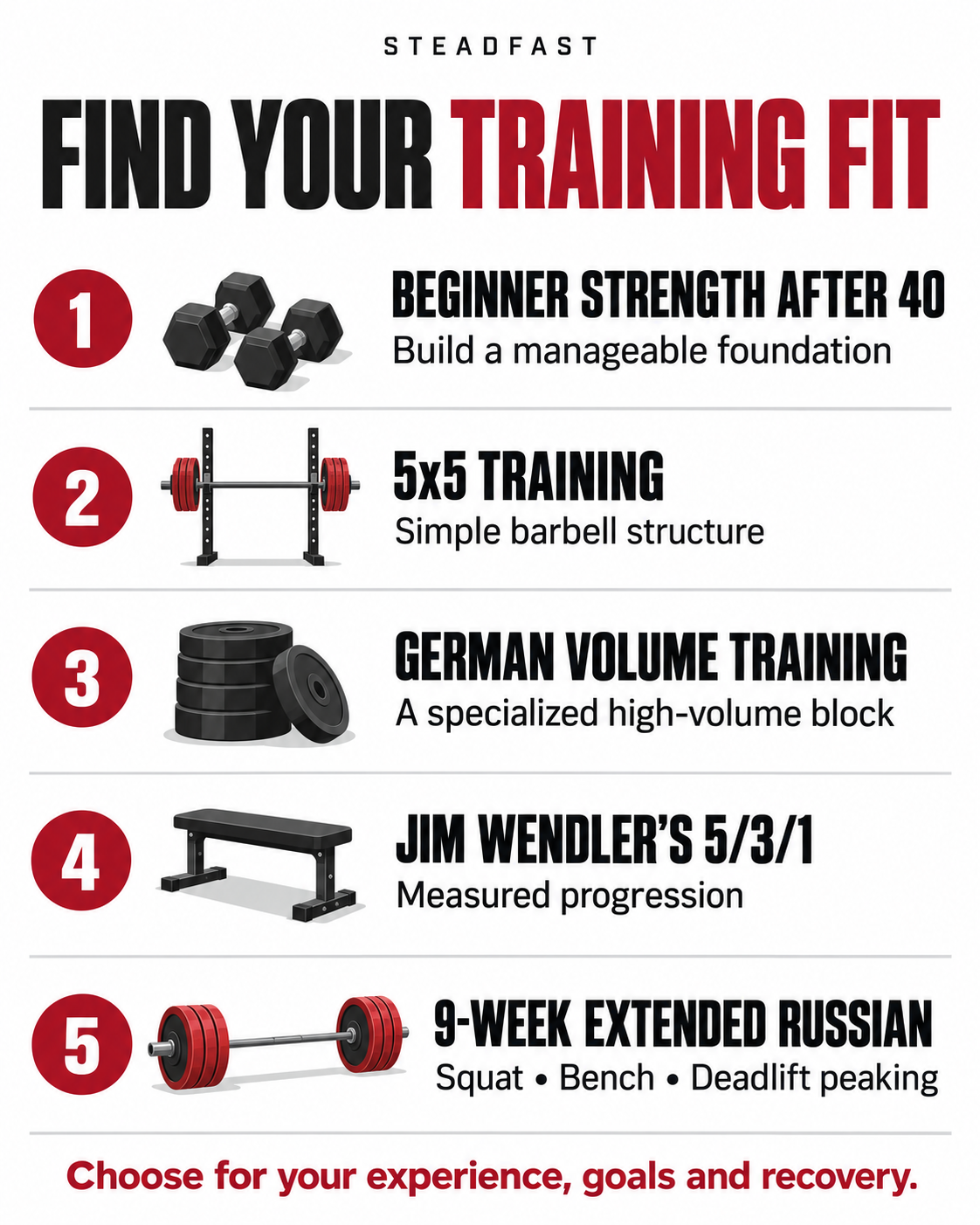
Starting again? I’d begin with a manageable foundation rather than the most dramatic program name.
Want clear barbell practice and simple tracking? I’d compare an appropriate 5×5 version with your current ability and schedule.
Want a longer-term plan with small, planned weight increases? I’d look at a suitable version of 5/3/1.
Already lifting regularly and curious about trying more sets to build muscle? We can discuss GVT, including whether a smaller dose would make more sense.
Experienced, confident with the lifts, and preparing for a heavy-lift test? Then we can have a serious conversation about the nine-week Russian routine.
These are options to discuss, not five plans you can swap without thought. I’d rather help you choose one plan you understand than watch you combine all five into a scheduling emergency.
| Same goal | Example: two people both want to get stronger. |
|---|---|
| Different starting points | One is learning to squat; the other has trained for years and has a lifting test coming up. |
| My approach | I’d start the first with basic practice. I’d ask the second more questions about a focused training block. Same goal, different starting points. |
Before the first working set
Warm up with easy movement and lighter practice sets for the lifts ahead. For lifts that need them, use rack safety bars and a trained spotter who can help if you get stuck. Choose weights and a movement range you can control. Stop for sharp pain or other symptoms that worry you, and get appropriate help. Finishing the spreadsheet can wait.
If a health condition, injury, or medical restriction could affect training, get advice from a qualified health professional and coach. This article explains options. It is not a personal workout plan, and you do not have to test your heaviest lift.
| What happens | Example: if a practice squat brings on sharp knee pain, I would stop the squat and get appropriate guidance. |
|---|---|
| What not to do | I would not add weight to see whether the pain goes away. |
| The priority | The plan can change; the warning sign gets attention. |
Let’s pick the plan that fits
Tell me what you want from your next training block, what equipment you have, and how many days you can honestly protect. I’ll start there.
Book a free strength and mobility assessment with Steadfast. We can work out where you are now and which direction makes sense next.
Bring your questions. I’ll bring enthusiasm. The barbell can wait until we have a plan.
| Useful details | Example: tell me, “I have dumbbells, two free evenings, and I want to get stronger for weekend hikes.” |
|---|---|
| Why they help | That gives us a useful place to start. |
| Less useful | “Give me the hardest plan” gives us much less. |
Frequently asked questions
Which program should I choose if I’m over 40?
I wouldn’t choose by age alone. Your experience, movement skills, goals, schedule, and health needs matter. If you’re new or returning, a manageable foundation is the place I’d start.
| Example | Example: a 45-year-old beginner and a 45-year-old experienced lifter may need very different starting plans. |
|---|
Are 5×5 and 5/3/1 the same thing?
No. 5×5 means five sets of five reps, a format used in different routines. Jim Wendler’s 5/3/1 is a training system with several plans and rules for adding weight. Read the actual version you plan to follow.
| What it says | Example: “5×5” tells you five sets of five. |
|---|---|
| What is missing | It does not tell you the weight, rest time, or what to do next week. |
Is German Volume Training automatically better for muscle growth?
No. A small study of modified GVT did not show better overall results from ten sets than five. More work needs a reason, and your ability to recover matters. [4]
| Example | Example: feeling more sore after ten sets does not, by itself, show that you built more muscle. |
|---|
Is the nine-week Russian routine the six-week squat routine?
No. The extended version discussed here trains the squat, bench press, and deadlift over nine weeks. The six-week squat routine is a different layout. Neither should be treated as a guaranteed personal-record generator. [6]
| Example | Example: a six-week sheet that lists only squats is not the nine-week squat, bench, and deadlift plan discussed here. |
|---|
Is this a downloadable workout plan?
No. This article compares approaches so you can make a more informed choice. It does not include a full workout schedule, personal weight targets, or a printable training log.
| What the log does | Example: the 5×5 log above helps explain the format. |
|---|---|
| What it does not do | It does not tell you which weight to lift tomorrow. |
Sources
[1] ACSM, March 17, 2026: updated resistance-training guidance for healthy adults.
[2] Bodybuilding.com: Gaining Muscle After 40: A Complete Beginner’s Guide, Alex Stewart. Used to identify the selected beginner framework, not to endorse all age-related claims.
[3] Bodybuilding.com: 5 Best Bodybuilding Programs for a Chisled Physique. Used to identify the 5×5 and GVT examples, not to endorse promotional muscle-gain claims.
[4] Amirthalingam et al., 2017: Effects of a Modified German Volume Training Program on Muscular Hypertrophy and Strength, randomized study, 19 men, six weeks.
[5] Jim Wendler: The 5/3/1 Philosophy for Beginners, official author guidance.
[6] Extended Russian Routine, archived program layout at e-normous.biz. This is a program-description source, not clinical evidence or verified proof of historical authorship.
Enjoy our strength and mobility articles?
Add Steadfast Strength and Mobility as a preferred source on Google to see more of our training advice, educational articles, and practical fitness information.
Or choose Steadfast in Google’s source preferences

Be the first to comment