
Get Fitter Without Turning It Into Punishment
FULL BODY STRENGTH AFTER 40 · PART 6 OF 8
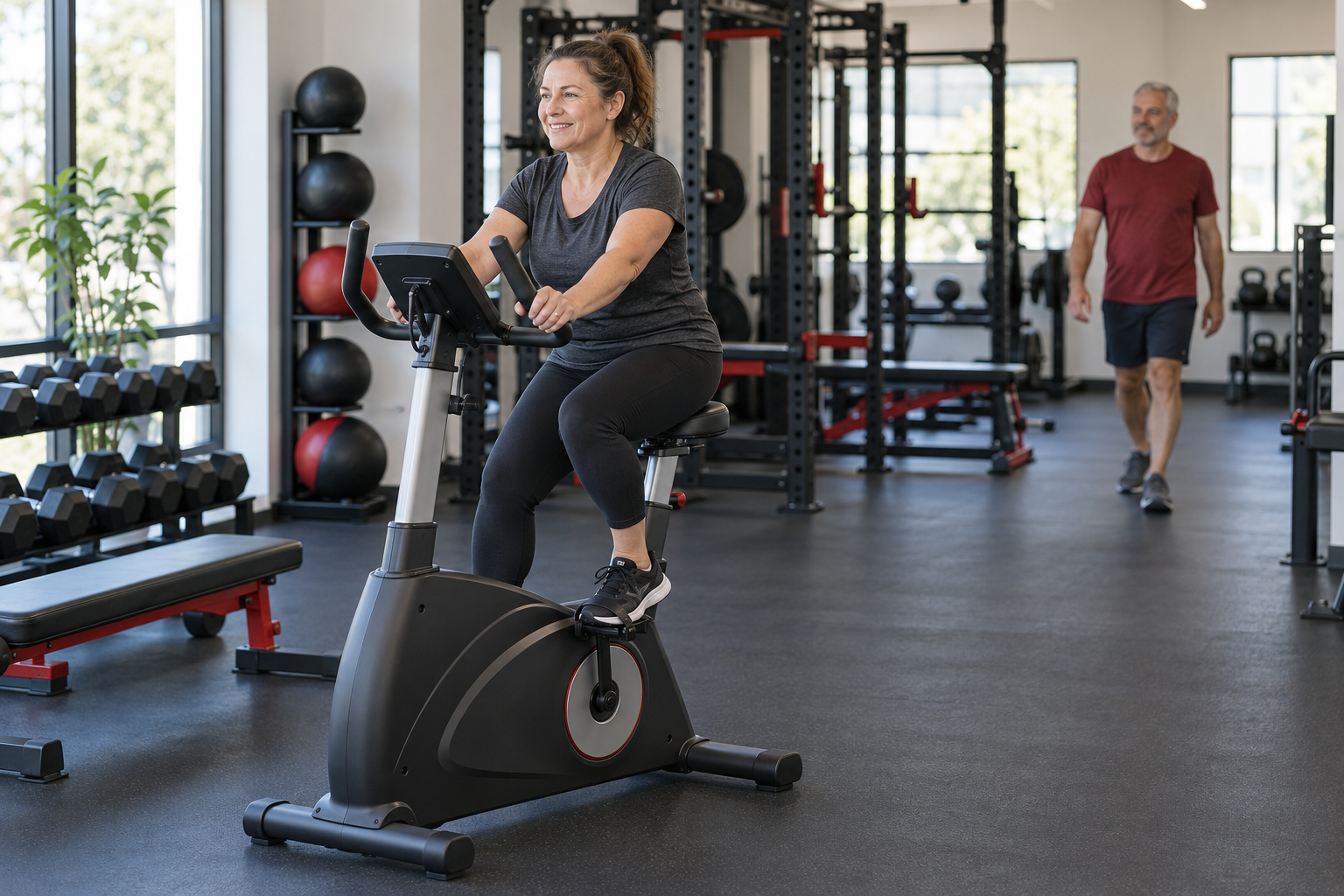
You can lift the grocery bags, but carrying them up the stairs still leaves you winded. Or you enjoy a brisk walk, but want more strength when you climb a hill or pick something up. Those are useful goals to bring into the same training plan.
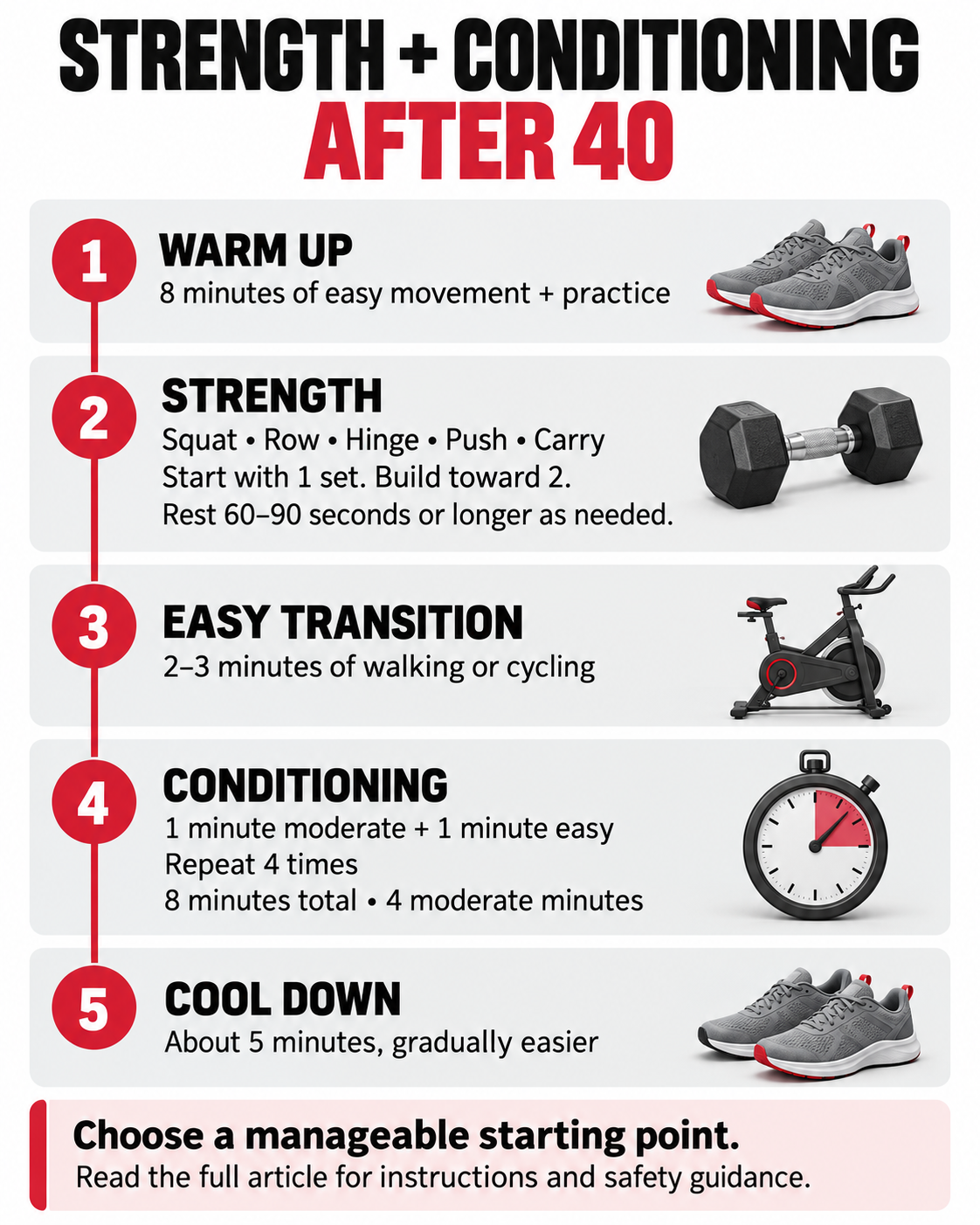
A strength and conditioning workout after 40 can be straightforward: practice a few full-body strength movements, take enough rest to keep them controlled, then add a short block of manageable walking or cycling. You do not need to turn every exercise into a race.
This sixth installment builds on Part 5, strength and stability. The focus now is how to add conditioning without rushing your lifts or exhausting yourself for the rest of the day. You can repeat an earlier session instead if it still fits you. The series offers options, not eight tests you must pass in order.
Check your starting point
If you have been away from exercise, begin with the first 30 days back in the gym. You may need comfortable walking and basic movement practice before combining strength work with intervals.
Get individual guidance if you have a condition that limits exercise, recent surgery, an active injury, unexplained loss of exercise tolerance, or restrictions on lifting or exertion. Follow your clinician’s limits even when a workout feels manageable.
Stop for chest discomfort, faintness, new dizziness, unusual severe breathlessness, or a fast or irregular heartbeat that feels abnormal. Seek prompt medical advice. Call emergency services for possible heart-attack symptoms, fainting, or severe or persistent symptoms. Sharp or worsening joint pain is also a reason to stop that movement, not finish the set. 6
Give strength and conditioning separate jobs
During the lifting portion, your job is to move a manageable load through a range you can control. During conditioning, your job is to sustain a chosen pace and recover between efforts. Separating the blocks makes both easier to judge.
Strength comes first in this example so you can practice the lifts before additional fatigue builds. That is a programming choice, not a rule for every person or goal. If combining the two leaves either block feeling poor, do them at different times or on different days.
The CDC recommends muscle-strengthening work on at least two days each week, along with at least 150 minutes of moderate aerobic activity or its vigorous equivalent. Smaller amounts still help, and activity can be spread across the week. This short session is one contribution to that plan, not the entire weekly target. 1
Warm up for about eight minutes
Walk or pedal easily for five minutes, gradually increasing your pace while keeping it comfortable. Then spend about three minutes rehearsing the movements: a few chair stands, unloaded hip hinges, wall pushups, and light rows.
Use the practice repetitions to check equipment, footing and range of motion. If the rehearsal feels unusually difficult or symptoms appear, change the plan rather than treating the warmup as a hurdle to push through. The American Heart Association recommends easing into exercise and slowing down gradually afterward. 4
The full body strength workout
Complete one set of each exercise in order for your first practice session. When you are ready for two sets, finish both sets of an exercise before moving on. Rest about 60–90 seconds between sets and exercises, and longer whenever you need it. The clock does not decide when your breathing and control are ready.
| Exercise | Each set | Sets | Starting option |
|---|---|---|---|
| Squat to a bench or chair | 8–10 repetitions | 1, building to 2 | Bodyweight first; add a goblet hold if appropriate. |
| Supported one-arm dumbbell row | 8–10 each side | 1, building to 2 | Use a sturdy fixed support; switch sides without rushing. |
| Dumbbell Romanian deadlift | 8–10 repetitions | 1, building to 2 | Practice the hip hinge without weights first. |
| Wall or fixed-counter pushup | 6–10 repetitions | 1, building to 2 | Use a higher hand position for less resistance. |
| Farmer’s carry | 20–30 seconds | 1, building to 2 | Use a clear route and a load you can carry steadily. |
Choose a load that lets you finish with roughly two or three more controlled repetitions available. You do not have to prove that estimate by trying them. Stop earlier if your technique changes. For carries, stop before your grip, posture or walking becomes unreliable.
ACSM’s 2026 resistance-training position stand supports useful training without taking every set to muscular failure. It also notes that an exact repetitions-in-reserve target is not firmly established. The sets, reps and effort above are a manageable starting example, not a universal optimum. 3
Coaching cues for each movement
Squat to a bench or chair
Set the chair against a wall so it cannot slide. Keep your feet planted, sit back and down with control, then stand. Touch the seat gently rather than dropping onto it. Use a higher seat or less depth if that gives you a more comfortable movement. Add a weight only after the bodyweight version feels steady.
Supported one arm row
Place one hand on a sturdy bench or fixed support. Keep your trunk steady as you draw the dumbbell toward your hip, then lower it slowly. Avoid twisting or jerking to finish. A seated cable row is an alternative if you have suitable equipment and know the setup.
Dumbbell Romanian deadlift
Stand with a small bend in your knees and the weights close to your legs. Move your hips back while keeping your trunk steady, then return to standing. Stop the descent where you can control it; reaching the floor is unnecessary. If the hinge is unfamiliar, practice without weights or get a coach to check it before loading it.
Wall or counter pushup
Use a wall or a counter that cannot move. Keep your body in a long line, lower your chest toward the support, then press away. Move to a higher support if the movement is too difficult. Choose a hand position and depth that feel comfortable rather than forcing a particular shape.
Farmer carry
Hold a manageable dumbbell at each side and walk with short, steady steps. Keep the weights clear of your legs and turn slowly. Put them down before your grip opens or you start leaning. If loaded walking feels unstable, omit it and get help choosing an appropriate supported alternative. Breathe throughout all five exercises.
Add eight minutes of controlled conditioning
After lifting, settle onto the bike or walking route and spend two or three minutes moving easily. Check that you can slow down, change settings and move comfortably. Then try the following block.
| Phase | Duration | What it should feel like |
|---|---|---|
| Moderate work | 1 minute | Breathing is deeper, but you can still talk. No sprinting. |
| Easy recovery | 1 minute | Reduce the pace enough for breathing to settle. |
| Repeat | 4 rounds total | Eight minutes, with four minutes of moderate work. |
The CDC’s talk test describes moderate effort as being able to talk but not sing. If you can manage only a few words before pausing for breath, reduce the pace for this session. Your clinician’s instructions take priority over the talk test. 2
This is moderate interval training, not all-out HIIT. A timer simply organizes the changes in pace. You can use level walking, comfortable stationary cycling or another familiar activity that fits your needs. “Low impact” does not guarantee low effort or suitability for a painful joint.
If one minute of recovery is not enough, make it longer. If four rounds are too much, try two or three, shorten the work portion, or stay with easy continuous movement. There is no benefit to forcing the final round when your pace or movement is falling apart.
Finish with about five minutes of progressively easier walking or pedaling. Extend the cooldown if you need more time to settle. Do not jump straight from a demanding effort to standing still. 4
Adjust the session before abandoning it
| What you notice | A practical adjustment |
|---|---|
| Your legs are tired after lifting | Reduce or skip the intervals that day. You can do conditioning separately. |
| Walking bothers a joint | Try a familiar, comfortable bike setup if suitable. Stop if symptoms persist; do not assume another machine solves the problem. |
| You feel rushed between exercises | Take longer rest and reduce the number of sets. Keep the movements controlled. |
| You cannot recover during the easy minute | Slow the work pace, extend recovery or reduce the rounds. |
| The workout disrupts the next day | Reduce the next session’s dose. Persistent or unexplained symptoms need assessment, not repeated experimentation. |
Progress one part of the plan at a time
Repeat a manageable version until your pacing is consistent and you recover well enough for ordinary life and your next session. Getting through it once does not automatically mean you should make it harder.
For strength, first work toward the top of the repetition range with the same control and effort. Then make the smallest practical increase in resistance and return to the lower end. You can build from one set to two before adding load, but avoid increasing everything at once.
For conditioning, one option is adding a fifth one-minute work and one-minute easy round. That adds two minutes total, including one moderate minute. Another option is a small pace change while keeping the rounds and recovery the same. Choose one adjustment, then observe your response.
Shorter rest is not the default progression. Better control, steadier pacing and a session you can repeat are useful improvements too.
Fit it into the week you already have
If you already strength train twice weekly, use this as one of those sessions rather than adding another full workout on top. For example, try this session on Monday and a familiar strength workout on Thursday, with comfortable walks on other days as your capacity allows.
Begin with the conditioning block on one day and see how it fits. You do not need a demanding finisher after every lift. Our guide to rest days after 40 can help you think through the spacing.
Do not count all eight interval minutes as moderate work if half are genuinely easy. Likewise, lifting does not automatically meet your aerobic-minute goal just because your heart rate rises. Gradually build the rest of your weekly activity from a level you can manage. 1, 2, 5
Record more than calories burned
Write down your exercise variations, weights, repetitions, rest periods, interval rounds and pace. Add a short note about how you felt later that day and the following morning.
At the next session, ask whether your last set stayed as controlled as your first and whether the final interval matched the earlier ones. Over time, you may carry the same load more comfortably or manage the same pace with less effort. Avoid using sweat, soreness or a watch’s calorie estimate as the only score.
If weight management is a goal, you still do not need to make this workout punishing. Exercise can support a broader plan, but this routine does not promise a particular amount of fat loss. Recovery, food intake and consistency deserve attention alongside activity.
Frequently asked questions
Can I do strength and cardio in the same workout?
Yes, if the total session fits your capacity and recovery. This example puts controlled lifting first, then a brief moderate conditioning block. Separate them if fatigue makes either part less manageable.
Is this a HIIT workout?
No. The work portions are moderate, with easy recovery between them. You should still be able to talk. Faster breathing alone does not make a session HIIT, and you do not need an all-out effort here.
Can I use walking instead of a bike?
Yes, if walking is comfortable and appropriate for you. Choose a clear, level route where you can change pace safely. Avoid adding hills, a weighted vest or faster turns just to make the intervals feel harder.
What if I only have 20 minutes?
Choose either a shorter strength session or a short conditioning session, with a suitable warmup and cooldown. Do not squeeze the full routine into 20 minutes by dropping rest or rushing technique. You can do the other part another day.
How often should I do this workout?
Start by using it for one existing strength session and see how you respond. A broader weekly plan can include another strength day and aerobic activity on other days. The best arrangement depends on your training history, recovery and goals.
Can I follow this with joint pain or a chronic condition?
A general article cannot decide that for you. Follow any medical restrictions and get help with exercise selection and dose when needed. Do not push through sharp or worsening pain, new symptoms or unusual exercise intolerance.
Build a plan you can keep using
Choose a starting version you can repeat, record what happened and adjust from there. You can train strength and stamina without making exhaustion the goal of every session.
Want help choosing your exercises, effort and weekly schedule? Book a free strength and mobility assessment with Steadfast. We work with adults in Fairfax, Haymarket and online to build training around their starting point and goals.
Previous: Part 5, Strength and Stability Workout After 40. Next in the series: Partner Workout After 40, with ways to train together while choosing your own loads and pace.
Sources
1. CDC. Adult Activity An Overview.
2. CDC. What Counts as Physical Activity for Adults.
3. American College of Sports Medicine. 2026 position stand on resistance training prescription in healthy adults.
4. American Heart Association. Warm Up Cool Down.
5. CDC. Getting Started with Physical Activity.
6. American Heart Association. Develop a Physical Activity Plan for You.
Sources checked October 18, 2026. They support the general principles discussed here, not a clinical trial of this exact workout. The AHA warning-sign source is written for cardiac rehabilitation; its condition-specific exercise instructions are not applied to this routine.
Enjoy our strength and mobility articles?
Add Steadfast Strength and Mobility as a preferred source on Google to see more of our training advice, educational articles, and practical fitness information.
Or choose Steadfast in Google’s source preferences

Be the first to comment