
Magnesium glycinate for sleep after 40
Waking at night: what to know about magnesium form and dose
If you fall asleep without much trouble but wake up during the night, a bottle promising “better sleep” leaves a question unanswered: will it help with the part of sleep you're struggling with?
Research doesn't yet establish that magnesium glycinate keeps people asleep through the night. Keep that limit in mind when deciding whether to buy something, change your routine, or get help with an ongoing sleep problem.
The useful question is whether magnesium fits your needs. The form on the label is only part of that decision. The amount, your medicines, your health, and the reason you're waking all deserve attention.
Quick takeaway: Magnesium glycinate may be worth discussing with your healthcare provider, but it isn't an established solution for repeated night waking. Get advice before taking it if you have kidney disease or use medicines. Persistent sleep trouble, loud snoring, or waking up gasping deserve medical attention rather than another supplement experiment.
This article is general education. It does not diagnose a sleep problem or recommend a personal treatment or dose.
Table of contents
Start with the sleep problem
“I'm sleeping badly” can mean lying awake at bedtime, waking often, waking too early, or feeling tired despite enough time in bed. Describe what happens before deciding which product might help.
If you're waking at night, consider what else is going on. Has your schedule changed? Are you drinking caffeine later in the day? Does the room feel too warm? Are worries keeping you awake after you stir? These are clues to discuss, not proof of a cause.
Stress, changing schedules, alcohol, and the sleep environment can affect sleep. Menopause can also bring sleep problems. None of these automatically means you need more magnesium. NHLBI: insomnia causes
Your body clock is another consideration. Shift work or a schedule that conflicts with your usual sleep pattern can create a different problem from an inadequate nutrient intake. A clinician can help sort out what's happening. NHLBI: circadian rhythm disorders
Loud snoring, breathing pauses, and waking up gasping are reasons to talk with a healthcare provider about sleep apnea. Daytime sleepiness can be another sign. A supplement won't tell you whether you have it. NHLBI: sleep apnea symptoms
What glycinate research actually shows
A randomized study compared magnesium bisglycinate with a placebo, a lookalike capsule without the active supplement, in generally healthy adults who reported poor sleep. After four weeks, the magnesium group reported a small additional improvement in insomnia symptoms.
Those symptoms were measured with a questionnaire. The study did not establish that people stayed asleep longer, and it did not use objective sleep testing. Participants were aged 18 to 65, so the findings aren't specific to adults over 40. People with Crohn's disease and several other medical conditions were excluded. Read the trial
For someone considering a bottle, the takeaway is modest: there is a reason to keep studying glycinate, but there isn't a promise that it will solve your night waking.
The wider magnesium and sleep literature is limited and mixed. Different studies use different forms, participants, and ways of measuring sleep. A positive result with one form doesn't prove that every magnesium product works the same way. NCCIH: magnesium and sleep
Does the form matter?
It matters enough to read the label. It doesn't justify declaring that form matters more than dose.
“Glycinate” and “bisglycinate” are names for the same magnesium compound. The longer name alone doesn't make a product stronger or better. You still need to check its ingredients and the amount supplied per serving. Health Canada: ingredient names
Research on sleep also includes other magnesium forms. That doesn't give us a reliable winner for keeping people asleep. Separate trials aren't a fair head-to-head comparison when they study different people and measure different outcomes.
So resist choosing by the most impressive front label. A useful comparison starts with what the bottle contains and whether the product is appropriate for you. Claims about sleep, absorption, and stomach comfort are different claims; evidence for one doesn't automatically prove the others.
Read the amount that counts
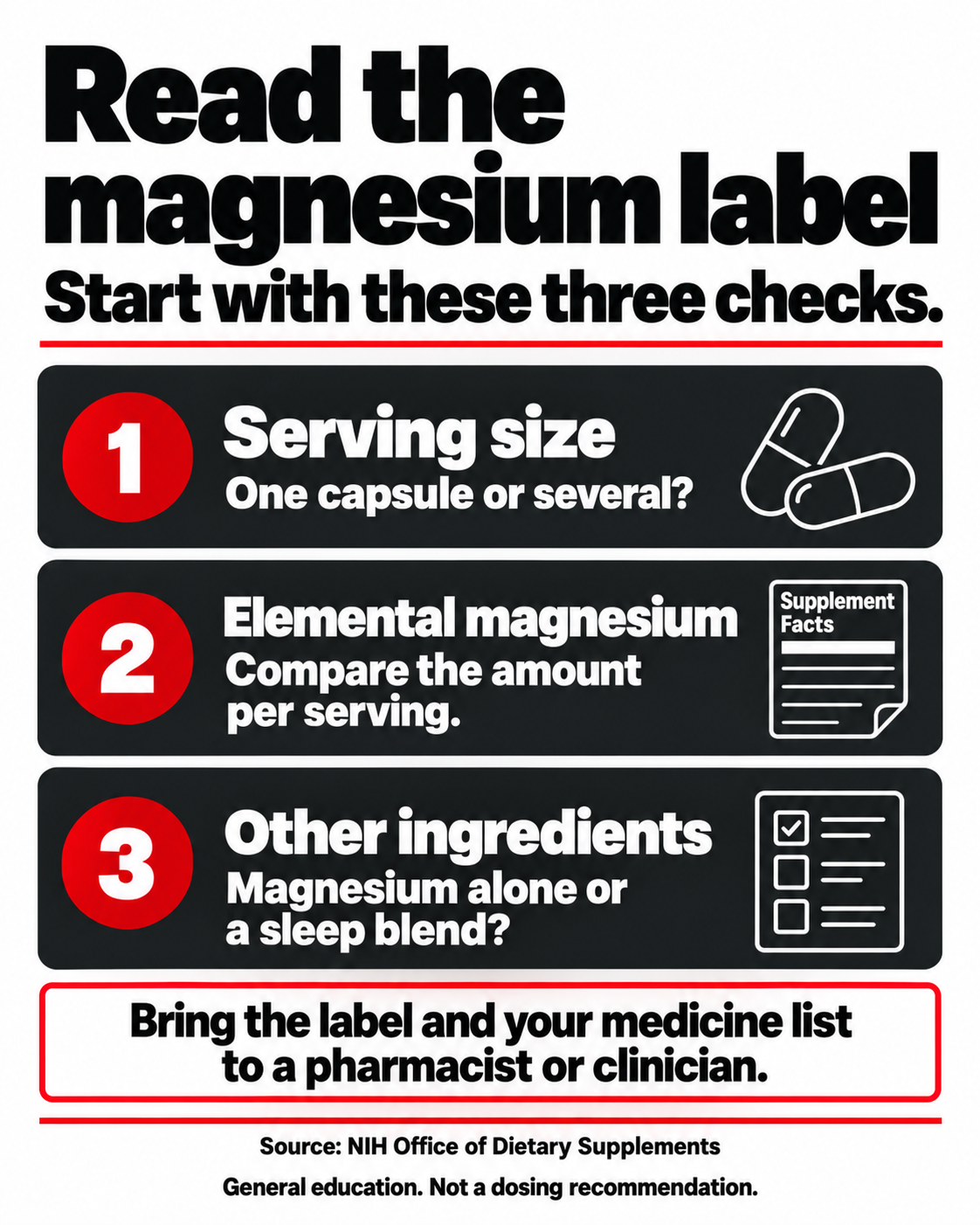
On a U.S. Supplement Facts panel, the magnesium amount is elemental magnesium: the magnesium itself, rather than the total weight of the compound carrying it. NIH: magnesium supplements
Start by checking:
- Serving size. Does the listed amount require one capsule or several?
- Magnesium per serving. Use the Supplement Facts amount when comparing products.
- Other ingredients. Is it magnesium alone, or a sleep blend with additional active ingredients?
A large number elsewhere on the bottle can be hard to interpret without that context. Compare like with like. The amount in a full serving is different from the amount in a single capsule if the serving uses several.
Also separate product quality from a promise of results. Independent quality testing can help assess what's in a supplement. It doesn't establish that the product will fix insomnia. NIH: supplement quality
Dose and timing
More magnesium isn't automatically more useful. For adults, the U.S. upper limit is 350 mg a day from supplements and medications, unless a healthcare provider recommends otherwise. Naturally occurring magnesium in food and beverages isn't included in that limit. This is a safety limit, not a recommended sleep dose or a guarantee that an amount below it is appropriate for everyone. NCCIH: magnesium precautions
Count magnesium across products. A separate capsule, a sleep blend, and a magnesium-containing medicine shouldn't be considered in isolation.
There isn't an established universal glycinate schedule that guarantees better sleep. A study's dosing routine tells you how that study was conducted; it doesn't prove that the same timing is best for every person.
If a clinician recommends supplementation, ask about the amount and timing that fit your medicines and health. Don't copy a research dose or increase it simply because a few nights haven't gone as hoped.
Who should check first?
Kidney disease needs particular caution. Impaired kidneys can have trouble clearing excess magnesium. Check with your treating clinician before starting a supplement.
Magnesium can also interfere with the absorption of certain antibiotics and osteoporosis medicines. Other medicines, including some diuretics and acid-reducing drugs, can affect magnesium levels. A pharmacist can review your full list and advise on any necessary separation between doses. Don't change prescribed medicines yourself. NIH: risks and interactions
If you are pregnant or breastfeeding, check with your healthcare provider before starting a supplement. FDA: supplement precautions
Bring the actual product label to that conversation. “It's just magnesium” leaves out the amount, serving size, and any other ingredients in the blend.
If you have Crohn's disease or another ongoing digestive condition, ask your care team whether supplementation is appropriate. NIH: magnesium and digestive conditions
Diarrhea, nausea, and cramping can occur with magnesium supplements. NCCIH: magnesium precautions If you develop side effects, stop and seek advice rather than increasing the dose or adding another product to compensate. NCCIH: supplement safety
Make your next step useful
Before adding something, make the problem easier to describe. A simple sleep diary can record bedtime, awakenings, wake time, caffeine or alcohol, and how you feel during the day. Bring it to an appointment if sleep is affecting your daily activities. NHLBI: diagnosing insomnia
You don't need perfect data. The point is to give the conversation more detail than “I'm tired.” Include medicines and supplements you already use, plus any changes that started around the same time as the sleep trouble.
Keep the basics realistic: a consistent sleep schedule and a quiet, dark bedroom are useful places to start. Alcohol may help you feel sleepy initially but can make sleep lighter and night waking more likely. NHLBI: insomnia treatment
If insomnia persists, ask about cognitive behavioral therapy for insomnia, usually shortened to CBT-I. This structured treatment addresses patterns that keep insomnia going and is generally the first treatment recommended for chronic insomnia. It goes beyond receiving a list of bedtime tips. NHLBI: CBT-I
A magnesium decision can fit within that wider conversation. It shouldn't delay finding out why sleep is difficult.
Frequently asked questions
Will magnesium glycinate stop me waking during the night?
That benefit hasn't been established. If repeated waking is your main concern, discuss that symptom with your clinician rather than choosing by a general sleep claim.
Should I choose glycinate or bisglycinate?
Those names refer to the same compound. Compare the finished products by their actual magnesium amount, serving size, and other ingredients rather than choosing by the longer name.
Can I combine it with melatonin or other sleep supplements?
Don't assume a combination works better or is safer. Ask a pharmacist or clinician to review the exact ingredients alongside your medicines. FDA: supplements and medicines
Do I need a supplement just because I am over 40?
Age alone doesn't tell you whether supplementation is needed. Consider your diet, health, and medicines with a qualified professional. A sleep complaint by itself doesn't identify a magnesium deficiency.
Before you choose a bottle
Before choosing a bottle, get clear about the sleep problem, check the label, and make sure any supplement fits your health and medicines.
Enjoy our strength and mobility articles?
Add Steadfast Strength and Mobility as a preferred source on Google to see more of our training advice, educational articles, and practical fitness information.
Or choose Steadfast in Google’s source preferences

Be the first to comment