
Steadfast supplement guide
Creatine monohydrate,
clearly explained.
Creatine is worth considering if you want a little more support for strength training. Start with what you need from it, then compare the label and the cost of a full serving. You don't need an elaborate supplement stack to make progress.
Table of Contents
Is creatine worth considering
Creatine can help with repeated short, intense efforts, including lifting and sprinting. The benefit varies between people. Evidence is less convincing for continuous endurance exercise. Your training, food and recovery still deserve most of your attention. NIH evidence overview
The scale may rise when you start because of water retention. That doesn't establish how much new muscle you've built. Some people also experience stomach discomfort. Judge your progress across weeks of training, not one workout or one weigh in.
Before buying, review supplements with your clinician or pharmacist if you take medication, have a medical condition, are pregnant or breastfeeding, or have surgery planned. Kidney disease needs individual medical advice. This guide is for adults, not a recommendation for children or teenagers. Supplement safety guidance
What to check on the label
1. Look for creatine monohydrate and the amount of creatine in a full serving. One scoop, tablet or chew isn't necessarily a serving. The weight of a flavored mixture isn't necessarily its creatine content.
2. Pick a format you can use consistently. Powder involves measuring and mixing. Chews may be easier to carry, but check how many you need and what else is in them.
3. Verify any certification for the exact product in the certifier's directory. Programs have different scopes, such as label accuracy, contaminants or banned substances. A testing logo doesn't prove a training benefit. NIH product quality guidance
4. Compare the cost of equivalent amounts of creatine. Divide the current total price, including delivery, by the number of full servings. Compare the same dose and check whether a displayed price requires a subscription. A container with more tablets may still contain fewer servings.
A claim that a form dissolves better is not the same as evidence that it produces better training results. A small trial found that buffered creatine did not outperform monohydrate on the measured outcomes. That does not prove every product is equal, but it is a reason to ask for direct evidence before paying for a claimed advantage. Form comparison trial
Plain powder or chewable tablets
Affiliate disclosure: Steadfast earns a commission from qualifying purchases through the Amazon links below. As an Amazon Associate, we earn from qualifying purchases.
These options illustrate two formats. The research in this article concerns creatine, not a trial comparing these brands. Neither option is a requirement for getting stronger.
Unflavored powder
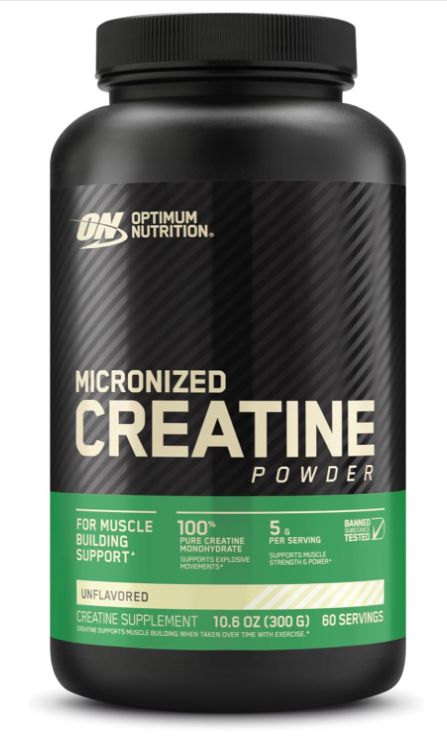
Optimum Nutrition Micronized Creatine
The unflavored powder suits someone who is comfortable measuring a serving into a drink. The manufacturer lists 5 grams of creatine monohydrate per serving, 60 servings in the 300 gram container, and no other ingredients for that unflavored label. Flavored versions have different labels, so check your selection.
The practical tradeoff is measuring and mixing. Compare the full serving cost with other plain monohydrate powders before deciding.
Grape-flavored tablets
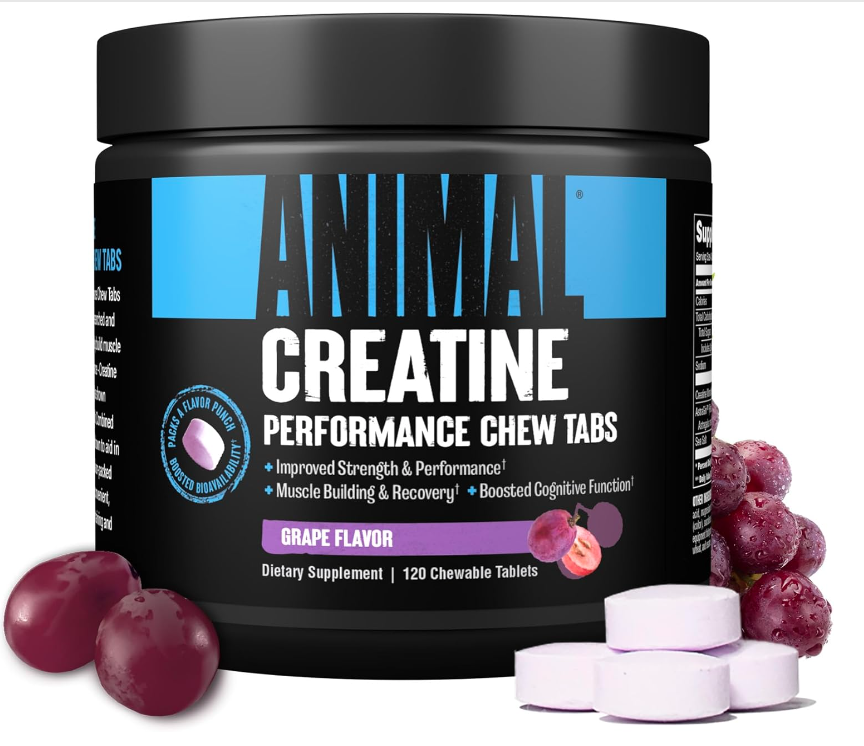
Animal Creatine Chews
Chewable tablets may suit someone who prefers not to measure powder or mix a drink. The manufacturer lists four chews as a serving providing 5 grams of creatine monohydrate. Its grape package shows 120 tablets, which works out to 30 full servings.
Check the selected flavor's full label for sugars, sweeteners and other ingredients. Four chews count as one serving, so compare cost per serving rather than cost per tablet. The chewable format alone doesn't establish a performance advantage over powder.
Check the flavor, container size, seller and current label before checkout. Prices and stock change. Inclusion here does not establish independent certification for either product.
What the evidence says
Your muscles store creatine and phosphocreatine, which help replenish ATP during brief, demanding efforts. Supplementation can increase those stores. Creatine monohydrate is the most widely studied form; paying more for a different form doesn't establish that it works better. NIH evidence review
For readers over 40, the important distinction is the population studied. A 2026 review of trials in adults 60 and older found a small additional strength benefit when creatine was combined with resistance training. Results for muscle mass and everyday physical function were less certain. That does not establish the same benefit for every adult over 40, or prove that creatine prevents age related muscle loss. Older adult research review
Keep a manageable training plan in place. Use progressive overload to build the challenge gradually, and record what you lift and how training feels. A supplement decision is easier to evaluate when your routine is consistent.
Why muscle gain headlines can disagree
Strength, lean body mass and visible muscle growth are different outcomes. A 2025 trial gave previously untrained adults 5 grams of creatine daily for a week before a 12 week lifting program. Creatine produced an early difference in measured lean mass, but no significant extra lean mass gain during the training phase. The study had no placebo group and did not directly measure hydration. It helps explain why an early body composition change shouldn't automatically be called new muscle. It also doesn't erase the wider evidence for strength and repeated hard efforts. Read the trial
For your own training, look at the work you can repeat: loads, repetitions and consistency. Avoid treating a single scan, scale reading or brand testimonial as proof of a supplement's effect.
Creatine for women and during menopause
Women can consider creatine for training too. Research reviews describe potential benefits, while also pointing out gaps across life stages and study designs. A general sports supplement result is not automatically evidence that creatine treats menopause symptoms or prevents fractures. Women's health research review
Choose based on your training goals and health situation, not a promise of hormone balance. Pregnancy and breastfeeding need a separate conversation with your healthcare professional; the enthusiasm around emerging research does not establish routine supplementation as safe in those settings.
Creatine and brain health show promise
Creatine has a role in the brain's energy system, which is one reason researchers are studying memory and mental performance. The research is promising, but it covers different populations, doses and tasks. Increasing brain creatine is not itself proof that someone's everyday thinking will improve. Brain function research review
A small 2024 study found improvements in selected memory and processing tasks during substantial sleep deprivation. That gives researchers a useful lead, but it involved 15 young adults and an experimental dose. It does not establish an everyday brain health benefit or a dose to copy. Sleep deprivation trial
Other results are less clear. A larger 2023 trial found results compatible with a small benefit, but did not reproduce the large effects seen in earlier work. Another small trial in healthy young adults found no significant cognitive improvement after six weeks. Promising is a fair description; guaranteed sharper thinking is not. Larger cognition trial and dose comparison trial
The useful question is which benefits hold up in larger studies and who is most likely to notice them. Keep brain health as an emerging potential benefit, alongside the more established training evidence. Creatine should not be presented as a substitute for sleep, medical care or treatment for a neurological condition.
Dose routine and expectations
A commonly studied daily approach for healthy adults is 3 to 5 grams of creatine monohydrate. This describes research, not an individualized prescription. Follow the product directions and your healthcare professional's advice, and check your other supplements to avoid duplicating ingredients. Operation Supplement Safety guidance
Loading is optional. Research has used about 20 grams daily, divided into four 5 gram portions for 5 to 7 days, followed by a maintenance amount. A lower daily approach builds muscle stores more gradually over several weeks. Larger servings may be harder on your stomach. You don't have to rush that process. Creatine research review
Choose a routine you can maintain on training and rest days. Research comparing use before and after exercise is limited. An early small study favored taking it afterward, but its conventional statistical comparison did not establish a clear timing difference. You don't need to organize your day around a promised magic window. Timing evidence review
Safety and kidney tests
Research is generally reassuring for healthy adults using studied amounts. That evidence doesn't establish safety for every medical condition or every product containing other ingredients.
Tell the clinician interpreting your blood tests that you take creatine. It can affect creatinine, a marker used in assessing kidney function. A 2025 review found a modest increase in creatinine without a significant pooled change in filtration rate, but the studies had limitations and evidence beyond one year was sparse. Don't interpret an abnormal result yourself or assume it is harmless. Kidney function research review
If you develop side effects, stop taking the supplement and contact your healthcare professional. Bring the full product label and your medication and supplement list. NCCIH safety guidance
Common questions
Do I need creatine to get stronger
No. Progressive training, adequate nutrition and recovery can build strength without it. Creatine is optional.
Is loading necessary
No. A lower daily approach raises muscle stores more gradually. Review the practical use section and the product directions before choosing an approach.
Does early weight gain mean new muscle
Not necessarily. Water retention can contribute. Follow your training and weight trends over time instead of treating an immediate increase as new muscle.
Are chews better than powder
The format alone doesn't establish better results. Compare creatine per full serving, other ingredients, convenience and cost.
Does third party testing guarantee results
No. Verify what the program tests and whether the exact product is listed. Product quality testing and evidence of a training benefit answer different questions.
What about hair loss
A 12 week randomized trial in resistance trained men found no significant difference in measured hair outcomes between creatine and placebo. That is reassuring evidence against the claim, but it cannot settle every dose, population or longer term situation. If you notice hair changes, discuss possible causes with a clinician rather than guessing. Hair outcome trial
Does creatine cause dehydration
Controlled studies reviewed in a systematic review did not show worse hydration or heat tolerance with the studied protocols. The studies were short, so this is not permission to ignore fluids, heat precautions or symptoms. Hydration and heat review
Decide what fits your routine
Compare creatine options using the full serving size and label, or keep working on your training routine first.
Download the free Supplement Scorecard to organize your comparison.
Explore the wider supplement guide or talk with Steadfast about your training.
Before you buy another supplement
Use the Supplement Scorecard to organize your comparison.
Download the free scorecardThis guide provides general education, not individualized medical advice. It does not diagnose, treat or prescribe for a medical condition.
Enjoy our strength and mobility articles?
Add Steadfast Strength and Mobility as a preferred source on Google to see more of our training advice, educational articles, and practical fitness information.
Or choose Steadfast in Google’s source preferences

Be the first to comment