
If getting back to the gym has left your knees, shoulders, or hips complaining, you need a way to adjust the session. A list of supposedly perfect exercises only gets you so far.
Joint friendly strength training over 40 means matching the exercise and the amount of work to what you can handle now, then checking how you respond. That includes the weight, movement range, support, exercise choice, sets, and weekly schedule. Your training history and symptoms matter more than an exercise’s reputation.
For a broader starting point, see our guide to strength training over 40. This guide is for general training decisions. It cannot diagnose joint pain or replace an individual rehabilitation plan.
What makes strength training joint friendly?
A useful exercise lets you practice the movement with control, apply an appropriate challenge, and return for the next session without a pattern of worsening symptoms. The same exercise can meet those conditions for one person and need changes for someone else.
There is no requirement to earn your way back to a barbell. The American College of Sports Medicine’s 2026 guidance supports individualized resistance training and recognizes benefits from bands, bodyweight exercises, and home-based routines. Equipment is a tool you choose for the job.
For people with arthritis, CDC guidance recommends starting slowly, choosing suitable resistance, and increasing difficulty in small steps. Existing arthritis does not automatically rule out strength work, but symptoms and any clinical advice should shape the plan.
Before changing an exercise, check the symptoms
Joint pain after returning to the gym at 40 deserves attention. Avoid automatically blaming age or deciding that a particular joint is damaged. Note where you feel it, when it starts, what makes it worse, and whether it affects ordinary activities.
- Stop the exercise causing pain if the pain is sharp or getting worse.
- See a healthcare professional for joint pain that keeps coming back or getting worse, especially when it disrupts sleep or daily activities.
- Seek urgent medical care for a hot, swollen joint or joint pain with fever or feeling unwell.
- Get immediate medical assessment for severe pain after an injury, a joint that looks out of place, or being unable to put weight on it.
These warning signs follow NHS joint-pain guidance.
If you already have a diagnosed condition, follow your clinician’s agreed limits. NICE recommends tailored exercise for osteoarthritis and notes that discomfort can initially increase. That is a reason for an individual plan, not permission to push through unexplained pain.
A practical framework: seven ways to adjust the session
Use these options as a coaching framework, not a test that tells you whether a joint is healthy. When symptoms are mild and there are no warning signs, make one change, try a small amount, and reassess. Stop if the response is worse or unclear.
1. Adjust the load
Load means the weight or resistance you use. Reduce it and see whether you can perform the movement comfortably and with control. A lighter dumbbell, a less demanding band, or a higher push-up surface can make the task easier to manage.
Keep some repetitions in reserve: finish the set while you could still complete a few controlled repetitions. The point is to find an amount of exercise you can repeat without symptoms getting worse. A lighter weight does not help much if you compensate by doing twice as many repetitions.
2. Adjust the range of motion
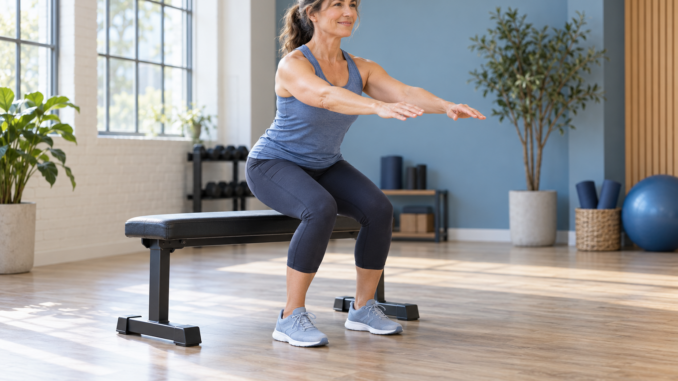
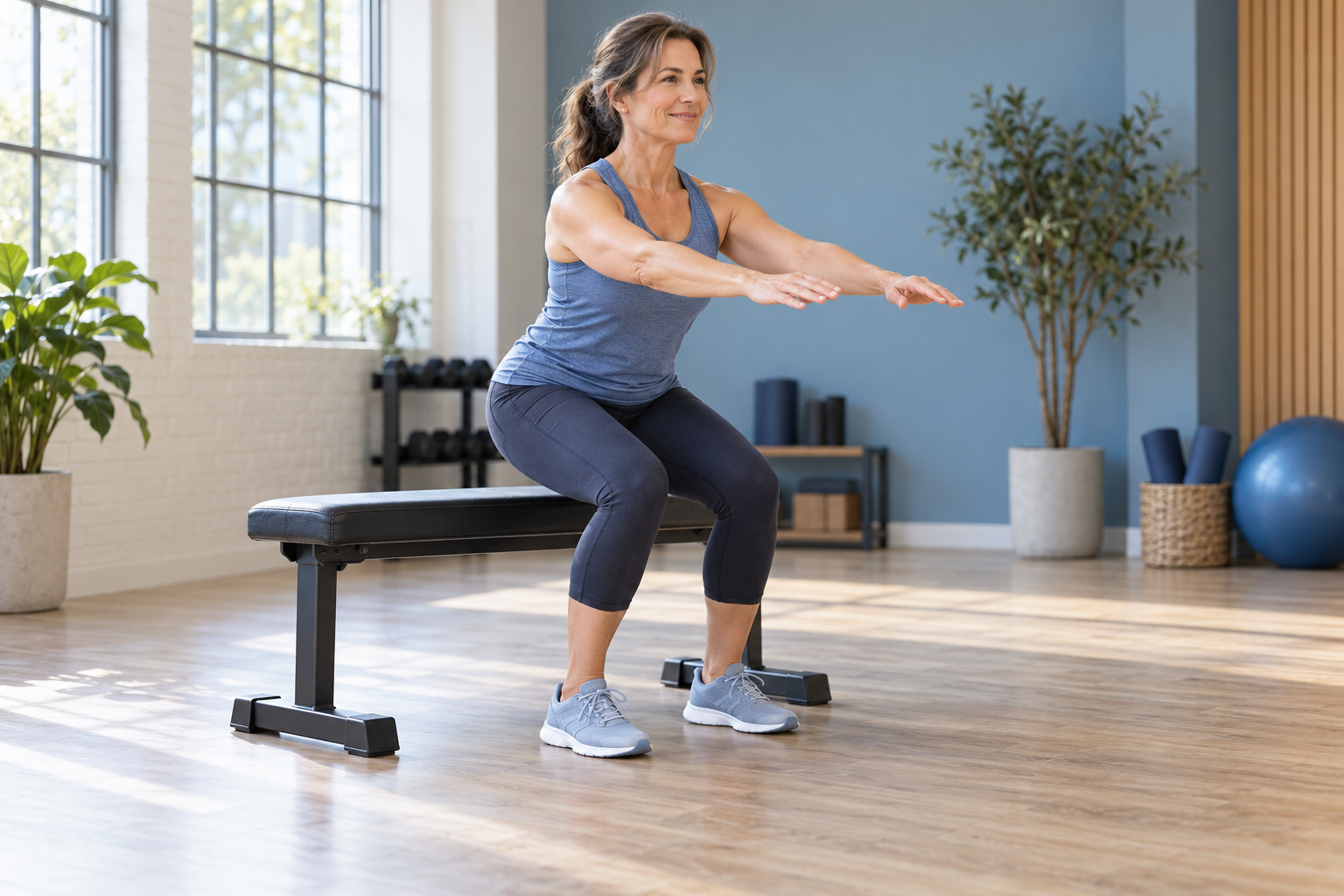
Range of motion means how far you move during an exercise. Try a shorter range that you can control without causing symptoms. A squat to a higher box or a press through a smaller comfortable range may be worth testing. Do not force an uncomfortable position simply because it appears in a demonstration.
Write down the range of motion you used. You can revisit it gradually if your response allows, rather than treating today’s limit as permanent.
3. Add support
If balance or holding your position makes a movement difficult, use a stable support. For example, you could hold a secure rail during a split squat, where you bend both knees with one foot in front of the other. In a chest-supported row, you rest your chest on a bench or pad while pulling weights toward your body.
Support changes the task. It is still strength training. Check that the setup is stable and that the extra support actually improves how the movement feels.
4. Substitute the exercise
If changing load, range, or support does not help, choose another way to train the intended movement or muscle group. An elevated push-up might replace a floor push-up. A comfortable sit-to-stand might replace a squat variation that currently irritates your knee.
These are examples to assess, not universally safe replacements. If several options cause pain, get qualified help rather than working through an ever-longer list.
5. Reduce the session volume
Training volume is how much work you do. Check the total sets and repetitions, including exercises that overlap. Squats, lunges, and step-ups can all add work for the same areas within one session.
As a practical trial, you might remove one set from an exercise or leave out an exercise that repeats work you have already done. Record the change so you can judge the response. Avoid adding extra repetitions to make the shorter session feel harder.
6. Adjust the weekly frequency
Weekly frequency means how often you train each week. A movement that feels manageable once may become troublesome when repeated across several sessions. Look at the entire week, including classes, sports, gardening, and physically demanding work.
You might space demanding sessions farther apart or spread the same weekly work into smaller sessions. Those are different changes: choose one based on when symptoms appear. Adding more sessions while keeping every session unchanged increases the total workload.
7. Check the later and next-day response
Before training, note your usual symptoms and how an everyday task feels. Afterward and the following morning, check again. Is walking, reaching, or getting out of a chair noticeably more difficult? Are symptoms lasting longer or rising across sessions?
A worse response is a reason to reduce or change the next dose and seek advice when symptoms persist. A comfortable session followed by an ordinary next day suggests you can repeat the same dose before progressing. It does not prove that an exercise is risk-free.
What this looks like in a real training decision
Suppose a returning lifter notices mild knee discomfort during a squat, with no swelling or other warning signs. First, stop that set. If symptoms settle, a few controlled sit-to-stands from a higher, stable chair could help assess whether a less demanding version is comfortable.
If it is, keep the trial brief and record the height, repetitions, and later response. If it still hurts, stop testing that pattern for the day. Train something else only if it is comfortable and appropriate. Repeated knee pain calls for assessment, not progressively more creative workarounds.
At the next session, repeat a tolerated version before adding difficulty. Change one variable at a time. More load, more depth, and more sets together make it hard to know what your body tolerated.
Build a plan you can keep using
A simple log is enough: exercise, setup, weight, sets and repetitions, symptoms during training, and the next-day response. Bring it to your coach or clinician if you need help. Specific observations are more useful than “everything feels bad.”
You do not need to solve every movement in one workout. Start with a small group of suitable exercises and build from there.
Frequently asked questions
Does joint-friendly training mean using light weights forever?
No. The appropriate load depends on your current ability, symptoms, goals, and any clinical restrictions. Start with a manageable dose and progress gradually when your response supports it. Heavy loading is not a required starting point.
Are machines always better for joints than free weights?
No single equipment category suits everyone. A machine may provide useful support, while its fixed path may feel awkward for someone else. Choose the setup that fits you and allows a controlled, tolerable movement.
Should I stretch through joint pain before lifting?
Do not force a painful position to prepare for training. Use comfortable movements and easy practice sets. Persistent or unexplained pain needs assessment; a longer warm-up is not a diagnosis or a treatment plan.
What if every version of an exercise hurts?
Stop testing that movement and speak with a qualified healthcare professional. A coach can adjust a training plan, but recurring pain may need assessment before deciding which exercises and loads are appropriate.
Get help choosing your starting point
If you would like support organizing your return to strength training, book a consultation with Steadfast Strength and Mobility. Bring your current routine, the movements you are unsure about, and any guidance from your clinician so we can discuss an appropriate next step.
References
Enjoy our strength and mobility articles?
Add Steadfast Strength and Mobility as a preferred source on Google to see more of our training advice, educational articles, and practical fitness information.
Or choose Steadfast in Google’s source preferences

Be the first to comment