
FULL BODY STRENGTH AFTER 40 · PART 5 OF 8
Step onto a curb. Carry a grocery bag. Get up from a low chair. Build the strength and control those moments ask for, with a workout you can adjust to your starting point.
Maybe you feel strong when both feet are planted, but less sure when you step onto a stair or shift your weight onto one leg. That is a useful detail to bring into your training.
This strength and stability workout after 40 combines a short supported balance drill with chair stands, low step-ups, rows, pushups, and carries. You will practice controlling your body while giving your muscles enough work to get stronger. A fixed hand support helps you choose the challenge instead of spending every repetition trying not to wobble.
This is Part 5 of the Steadfast Full Body Strength After 40 series. The earlier sessions covered your strength foundation, dumbbells, TRX, and beginner kettlebells. You can use this session as another option in your week. You do not need to complete all four articles first or replace a routine that already fits you.
Why train strength and balance together?
Strength helps you produce force. Balance involves controlling your position as your weight shifts. Getting onto a step asks for both: your leg has to lift you, and you have to manage where your body goes.
That is why this session has two kinds of work. The brief balance practice lets you focus on position while you are fresh. The strength exercises use a steady setup so you can challenge your muscles with controlled repetitions.
For adults 65 and older, the CDC recommends balance activities alongside aerobic activity and muscle strengthening on at least two days each week.1 That age-specific guidance does not mean everyone over 40 has poor balance. It does support keeping both strength and balance in view as you get older.
The American College of Sports Medicine’s 2026 guidance also emphasizes regular resistance training that fits the individual. Complicated programs and training to complete muscle failure are not essential for most healthy adults.2 The exact routine below is a coaching template, not a research-tested fall-prevention program.
Check your starting point and setup
This workout is for adults who can walk and stand independently and tolerate the listed movements, with hand support where needed. Recent surgery, an active injury, or medical restrictions may call for a different plan.
If you have had repeated falls, new or unexplained balance loss, dizziness, or a sudden change in how you walk, get medical guidance before trying to challenge your balance. A timed one-leg stand cannot tell you why your balance changed.
Use a firm, nonslip floor and shoes that stay secure on your feet. Move rugs, cords, pets, and spare weights out of the way. Place a chair without wheels against a wall. For standing support, use a fixed counter or securely installed rail. A chair back that can slide or tip is a poor substitute.
Stop for sharp or worsening pain, dizziness, chest discomfort, or unusual breathlessness. New severe symptoms, including sudden weakness or trouble speaking, need urgent medical attention.
A five-minute warmup
- Walk or march comfortably for about two minutes.
- Do five easy chair stands, using your hands if needed.
- Do five easy wall pushups.
- Practice a few low step-ups while holding the rail. Keep them easy.
Use the warmup to notice how you feel today. If the low step feels awkward, lower it or leave it out. You should not need a running start or a strong pull on the rail to get up.
Your strength and stability workout after 40
Start with the balance primer. Then complete both sets of one strength exercise before moving to the next. Rest 60 to 120 seconds between strength sets, or longer when needed to recover your breathing and control. Rest briefly between sides when necessary. For one-sided movements, finishing both sides counts as one set.
| Movement | Sets | Starting target | Main focus |
|---|---|---|---|
| Supported single-leg stance, before strength work | 2 | 10 to 20 seconds each side | Controlled weight shift |
| Chair stand | 2 | 8 to 12 reps | Leg strength |
| Supported low step-up | 2 | 6 to 8 reps each side | Stepping under control |
| Supported one-arm dumbbell row | 2 | 8 to 12 reps each side | Upper-body pulling |
| Wall or fixed-counter pushup | 2 | 6 to 10 reps | Upper-body pushing |
| Suitcase carry | 2 | 20 to 30 seconds each side | Grip and trunk control while walking |
These are starting ranges, not minimums you must push through. Shorter holds, fewer reps, lighter weights, and the easier options below all count. Keep the step-ups at body weight while you learn the movement.
How to do each movement
1. Supported single-leg stance

Stand beside a fixed counter with one hand resting on it. Keep your eyes open and look ahead. Shift your weight onto one foot, then lift the other foot just clear of the floor. Keep your standing knee relaxed and your hips level. Put the foot down before you start hopping or grabbing for support.
Cue: Stay tall. Keep the support within easy reach.
Easier option: Leave both feet on the floor and gently shift your weight from side to side while holding the counter. You can also shorten the hold. Rest 20 to 30 seconds between attempts if needed. The NHS includes supported one-leg stands and controlled step-ups among its balance exercises.3
2. Chair stand
Sit near the front of a stable chair with both feet planted. Lean forward slightly from your hips, press through your feet, and stand. Sit back down slowly until your weight is on the seat. Keep your feet in place rather than rocking repeatedly to build momentum.
Cue: Stand smoothly. Sit quietly.
Easier option: Use your hands on the armrests or a higher, stable seat. If you need your hands for assistance, keep them free instead of also holding a weight.
3. Supported low step-up
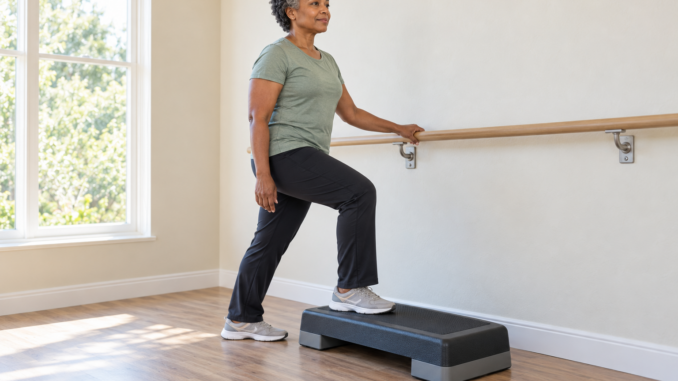
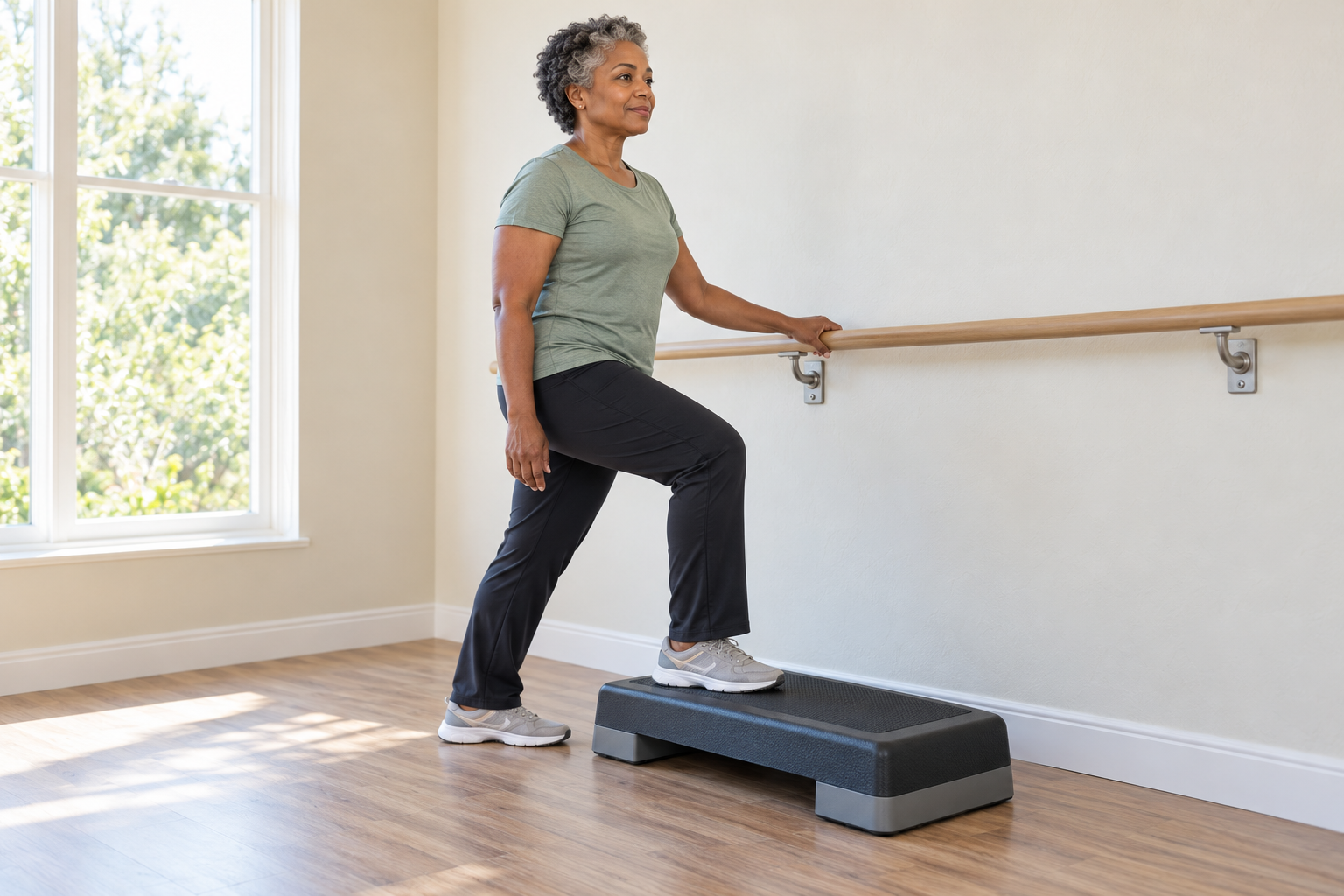
Stand facing a low, sturdy step beside a fixed rail. Hold the rail and put your entire lead foot on the step. Press through that foot to rise, then bring your other foot onto the step. Pause with both feet secure. Step back down slowly, one foot at a time. Finish the planned repetitions before switching your lead leg.
Cue: Whole foot on. Quiet step down.
Easier option: Use a lower step. If there is no secure setup, leave this exercise out and keep the chair stand. Do not improvise with a dining chair, loose books, or an unstable box. Keep hand support as long as you need it.
For example, if you can step up but drop quickly on the way down, the current height is too demanding for this session. Lowering the step gives you a more useful repetition.
4. Supported one-arm dumbbell row
Place one hand on a stable bench or fixed support. Keep both feet on the floor, soften your knees, and hinge forward enough for your other arm to hang. Pull the dumbbell toward your lower ribs, then lower it under control. Keep your torso steady.
Cue: Move the arm without twisting your body.
Easier option: Use a lighter dumbbell and a comfortable range. If the bent position continues to bother your back, stop and have an alternative assessed. You do not need to turn the row into a one-leg balance exercise.
5. Wall or fixed-counter pushup
Place your hands around shoulder-width apart on a wall or fixed counter. Step back to a comfortable distance. Bend your elbows and bring your chest toward the support, keeping your head, hips, and trunk moving together. Press away smoothly.
Cue: Move as one piece. Keep breathing.
Easier option: Use the wall or stand closer to it. Choose a comfortable range for your shoulders and wrists. Do not use a lightweight table or chair that can slide or tip.
6. Suitcase carry
Hold a manageable dumbbell beside one thigh. Stand tall with your shoulders level, then walk slowly along a clear, level path. Keep your steps natural and your torso upright. Stop before your grip opens or the weight pulls you sideways. Set it down before switching hands.
Cue: Carry one grocery bag without letting it pull you crooked.
Easier option: Use a lighter weight or a 10- to 15-second stationary hold beside a fixed support, with your free hand available. If your gait or grip is unreliable, skip the carry and get help selecting an alternative. Avoid stairs, obstacles, and tight turns while carrying.
Progress strength and balance separately
Keep a brief record of your reps, load, step height, and how much hand support you used. Also note how normal daily activities feel the next day. A useful starting rule is to make a small change only after two controlled sessions with manageable recovery.
- Chair stands, rows, and pushups: Build toward the top of the rep range while keeping about 2 or 3 good reps available. Then change one thing: a small increase in row weight, less help from your hands on chair stands, or a slightly lower fixed support for pushups.
- Step-ups: First make every descent controlled and reach 8 repetitions per side. Keep the rail. A higher step is optional and should not cost you control. You do not need to add weights.
- Balance practice: Build toward 20 comfortable seconds. If secure, try a slightly lighter hand contact while keeping the counter immediately available. Do not close your eyes, add a weight, or stand on a cushion to chase difficulty.
- Carries: Build toward 30 seconds per side with steady steps and level shoulders. Then consider a small weight increase and shorten the time again.
Here is what progress might look like: last week you used the chair armrests for 8 smooth stands. This week you do 10 with the same assistance and recover well. That is progress. You can work on the next change later.
If joint symptoms increase or soreness changes how you walk, reduce the next session and allow more recovery. Our joint-friendly strength training guide explains how to adjust load, range, support, and exercise choice. For scheduling, see how many rest days to take after 40.
Common questions
Does using a rail make a balance exercise less useful?
Support changes the challenge, and that can be helpful. Use enough to move with control. You can gradually use a lighter touch when you are secure, but removing the rail is not a required milestone.
Should I lift weights while standing on one leg?
For this starting session, keep those tasks separate. Use the counter for balance practice and a stable stance for your row and pushup. You can challenge your muscles without making the setup harder to control.
Can I do this workout if my knees hurt?
It depends on the cause and your response to the movement. A higher chair, lower step, or fewer repetitions may help, but none guarantees a suitable exercise. New, severe, swollen, or worsening knee symptoms deserve clinical guidance. Do not use this workout to test how much pain you can tolerate.
What if one side feels less steady?
Use the same manageable target for both sides and let the less steady side guide the starting difficulty. Keep support available. A new, marked, or unexplained difference needs assessment rather than extra repetitions.
Will this workout prevent falls?
No individual workout can promise that. Falls can involve health conditions, medications, vision, footwear, and the environment as well as strength and balance. Repeated falls or unexplained balance changes call for an assessment and an individualized plan.
How often should I do it?
Start with two nonconsecutive strength sessions each week. If this is new, begin with one set of each strength movement. Add work gradually based on control and recovery. This session complements appropriate aerobic activity; it does not cover your entire weekly activity plan.
References
1. Centers for Disease Control and Prevention. Older Adult Activity: An Overview. Recommendations for adults 65 and older.
2. American College of Sports Medicine. 2026 resistance training guidelines update. Guidance for healthy adults.
3. National Health Service. Balance exercises. General examples of supported practice.
Sources checked October 13, 2026. These sources inform general principles; they do not validate this exact routine or replace individual medical advice.
Enjoy our strength and mobility articles?
Add Steadfast Strength and Mobility as a preferred source on Google to see more of our training advice, educational articles, and practical fitness information.
Or choose Steadfast in Google’s source preferences