
The final bell rings. Your brain may still have twenty tabs open.
Thank you for reading this post, don't forget to subscribe!
There are assignments to grade, a parent message to answer, and something to prepare for tomorrow. Then comes the drive home, dinner, and everyone who needs you there. Somewhere in that schedule, you were supposed to fit in a workout.
If you finish the school day feeling overstimulated, another list of decisions can be the last thing you want. You have already spent hours answering questions, managing interruptions, and keeping things moving. Your workout should be simple to follow.
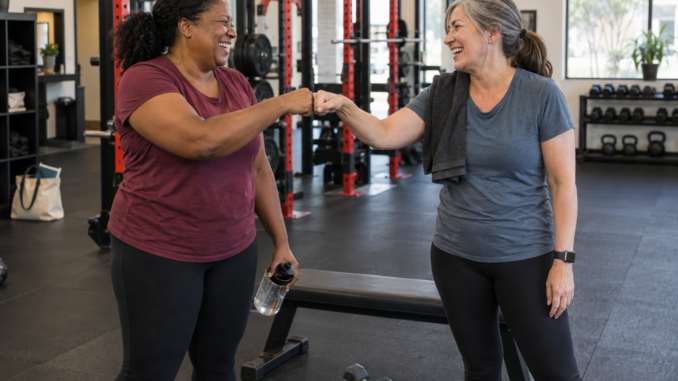
Picture meeting a friend at the gym, having a clear plan ready, and knowing someone is there to guide you. A little laughter between sets. Encouragement when the next repetition feels challenging. Time to work on your own strength with people you enjoy.
Train together. Build your own strength. That is the idea behind shared motivation: enjoy the session together while receiving guidance that fits your ability. This guide gives you two straightforward workouts, a shorter option for demanding days, and a way to make training part of your social life.
After a busy school day, keep training simple
A good session can feel welcoming and upbeat without adding pressure to an already full day. Fun might mean a laugh with a friend, celebrating a smoother set, or realizing an exercise feels more comfortable than it did last week.
Keep the structure familiar: warm up, follow a short list of exercises, rest, and finish. When you train with a coach, let them handle exercise selection, setup, and progression. Tell them how you are feeling so the plan can be adjusted where needed.
You can put energy into the work without having to organize every detail. And on the days you want fewer instructions and a steadier pace, say so. Simple training should leave room for the person doing it.
Start with the week you actually have
Before choosing exercises, look at your calendar. Which two windows could you realistically protect? Include travel, changing clothes, and getting home. A 35 minute workout can take considerably longer once those pieces are included.
Tuesday after school and Saturday morning might fit better than two weekday evenings. Another teacher may prefer going straight from school to the gym. Choose times that work with your responsibilities instead of borrowing someone else’s schedule.
Write down three decisions: your usual training time, your backup time, and what you will do if only a short session is possible. For example: “Tuesday after school; Thursday if a meeting runs late; a short home session if neither works.” That removes a decision from an already crowded day.
NEA Member Benefits describes educators fitting activity into their routines through practical changes and exercising with a partner. These are useful ideas to test, rather than proof that one schedule works for every teacher. Read the educator examples.
Why begin with two strength sessions?
The CDC recommends muscle strengthening activity that works the major muscle groups on at least two days each week, alongside aerobic activity. Two sessions can therefore be a sensible starting structure. They are not a complete replacement for walking, cycling, or other aerobic activity. See the adult activity guidelines.
ACSM’s 2026 resistance training guidance emphasizes regular participation and individualization. Machines, bands, free weights, and bodyweight exercises can all have a place; a complicated routine is not a prerequisite for getting started. Read ACSM’s updated guidance.
For this starter plan, leave at least a day between strength sessions. Work your legs, hips, upper body, and trunk across the week. Start with manageable practice, then build the amount of work as your technique, schedule, and recovery allow.
You do not need to earn your place in the gym by getting fit first. Learning how to set up the equipment and choose an appropriate resistance is part of the process.
A practical strength routine for a busy teacher
The following is an illustrative coaching plan for generally healthy adults beginning or returning to exercise, not a research protocol or an individualized prescription. Exercise choices and effort should be adjusted for your experience, symptoms, and any medical restrictions. If you are returning after surgery or managing a condition that limits exercise, get appropriate guidance before using it.
Allow roughly 30 to 40 minutes initially, with more time if you need help learning the movements. Begin with about five minutes of comfortable walking or cycling, then a few controlled movements relevant to your session and light practice repetitions of the first exercises. Dynamic stretching can be part of that preparation.
For the exercises below, start with one working set while learning. Add a second when the session feels manageable and you recover comfortably. A starting range of 8 to 12 controlled repetitions gives you a simple target; stop before technique deteriorates. Use a resistance that leaves about three good repetitions available. This is an estimate, not a test of how much discomfort you can tolerate.
Session A
| Movement | Starting exercise | Useful adjustment |
|---|---|---|
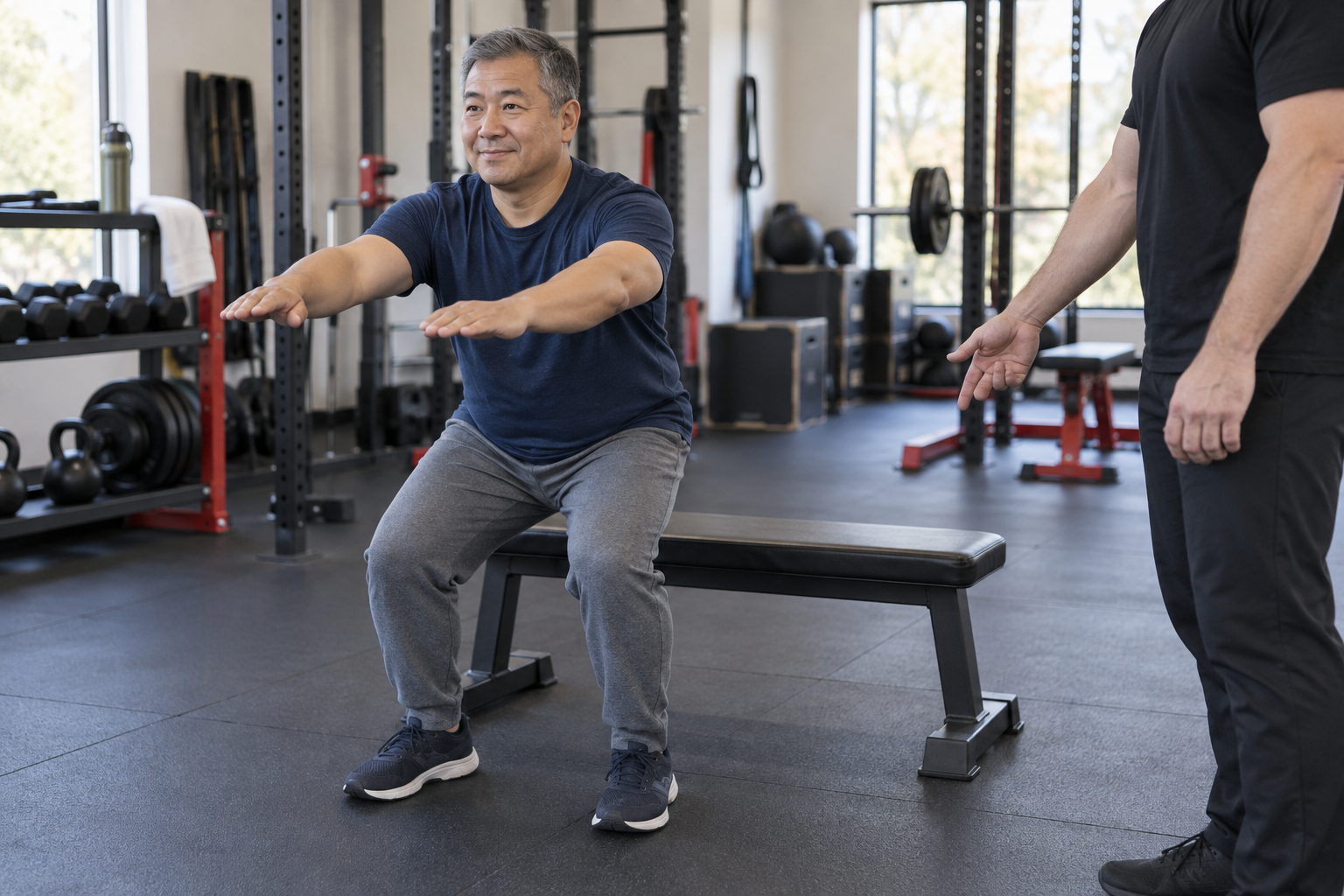
| Squat pattern | Sit to stand from a stable bench | Use a higher seat or light hand support |
| Upper body push | Chest press machine | Use a comfortable grip and adjust the seat |
| Upper body pull | Seated cable row | Choose a light load and keep your torso steady |
| Hip extension | Glute bridge | Use a comfortable range; choose a standing alternative if floor access is difficult |
| Trunk control | Standing cable press against rotation | Use light resistance for 6 to 8 controlled repetitions per side |
Session B
| Movement | Starting exercise | Useful adjustment |
|---|---|---|
| Leg strength | Leg press | Use a comfortable depth with your back supported |
| Upper body push | Pushup against a stable elevated surface | Raise the surface to reduce difficulty |
| Upper body pull | Lat pulldown | Use a comfortable grip; repeat the row if reaching overhead is uncomfortable |
| Back of thigh | Seated leg curl | Adjust the machine to fit before adding resistance |
| Trunk control | Standing cable press against rotation | Repeat the same comfortable version from Session A |
Rest about one to two minutes between sets, longer if needed to feel ready. Move deliberately and keep breathing. Stop an exercise that causes sharp pain, dizziness, or other concerning symptoms. A coach can help select a different movement rather than asking you to force an unsuitable one.
This is a starting framework, not a requirement to complete every exercise regardless of how you feel. Learning four movements well can be a more useful first session than rushing through five unfamiliar ones.
How hard should the workout feel?
Your first week should teach you the routine. It does not need to establish your limits.
Use the last few repetitions as a check. Are you maintaining the same range and control? Could you complete a few more without changing your technique? If you are holding your breath, rushing, or twisting to move the weight, reduce the demand.
Repetitions in reserve describes the estimated repetitions left in a set. RPE describes perceived effort using a specified scale. Both can help you communicate with a coach, but neither replaces learning the movement or paying attention to symptoms.
Record the exercise, resistance, and repetitions. Add a brief note such as “comfortable,” “needed more rest,” or “seat position felt wrong.” Useful notes make the next session easier to plan.
The shorter option for a demanding week
Some days the original plan will not fit. Decide in advance what a shortened session looks like so a late meeting does not require inventing a new workout in the parking lot.
Allow about 15 to 20 minutes. Warm up, then choose three familiar exercises: one lower body movement, one push, and one pull. Complete one or two controlled sets of each, with normal rest. Leave out the extras instead of racing between exercises.
This smaller session does not provide the same training dose as the full plan. Its purpose is to keep a manageable amount of practice in a crowded week. If it becomes your usual routine, review whether it still covers your goals and muscle groups adequately.
If you are ill, unusually exhausted, or need recovery, take that seriously. A shorter workout is an option, not an obligation. Resume with an appropriate session when you are ready.
Progress without making every week harder
Repeat the basic routine long enough to learn it. You do not need a completely different exercise menu every visit.
Suppose you start a row with eight controlled repetitions. Over later sessions, you reach ten and then twelve using the same resistance and similar effort. Once you can repeat the top of your target range comfortably, try the smallest available increase and return toward the lower end.
This is one example of double progression. It puts progressive overload into a trackable process. You can also progress by improving control, using an appropriate additional range, or completing a planned second set.
Change one thing at a time. During a difficult school week, repeating last week’s manageable session may be the right decision. Review your training over several weeks instead of demanding a personal record every Tuesday.
Shared motivation: train with your friends
Bring a colleague or two. Catch up between sets, encourage each other, and celebrate the little victories. You already share parts of the school day. A workout can give you something enjoyable to share outside it.
Shared motivation can be as simple as a friend saying, “See you there,” or noticing that the weight you struggled with last month now moves smoothly. There is room for effort, laughter, and a well earned high five in the same session.
The aim is a friendly, energetic experience where everyone can work at an appropriate level. You can cheer for your friend and follow your own plan. There is no need to turn the session into a competition.
Choose someone with a compatible schedule. Agree on what happens if one person cannot attend so that every cancellation does not automatically cancel both workouts.
You do not need matching strength, experience, or goals. In a coached session, one person might use a bench sit to stand while another uses a weighted squat. The shared appointment provides structure; the exercise and resistance should still fit each participant.
Ask how the coach handles different abilities, equipment availability, and instruction time. A small group should still allow you to ask questions and receive useful feedback.
A Fairfax option for teachers who want coaching
Steadfast Strength and Mobility offers semi private training for two to three teachers at District Barbell in Fairfax, with a minimum of two participants. The current rate is $55 per person, per session, including strength and mobility coaching, individual exercise adjustments, and nutritional guidance for practical eating habits.
Individual guidance. Shared motivation. Maximum three per session. Train with friends, receive clear instructions, and work toward your own goals. Nutritional guidance focuses on practical eating habits that support those goals.
Session times depend on group and facility availability. Individual personal training is also available for people who prefer a session focused entirely on them.
Start by discussing your goals, experience, and realistic schedule. A complimentary consultation and assessment can help establish whether the format fits. Steadfast is an independent coaching business partnered with District Barbell; this is not presented as a school district program.
Explore personal training for Fairfax teachers, or book a consultation. Bring a colleague if you would like to discuss training together.
Questions teachers often ask
Does being on my feet all day count as exercise?
Movement during the day matters, but standing and walking between classrooms do not necessarily provide the same challenge as planned strength training. Consider what your day already includes, then choose exercise that addresses what is missing.
Should I train before school or after school?
Choose the time you can repeat without routinely sacrificing sleep or essential responsibilities. Test a schedule for a couple of weeks and adjust it based on actual attendance, travel time, and how you feel.
Do I need to feel sore for a workout to count?
Soreness is not the goal of this plan. Judge progress through completed sessions, controlled repetitions, appropriate increases in resistance, and tasks becoming more manageable. Repeated soreness that disrupts work is a reason to review the training dose.
What if I miss a session?
Use your backup appointment or resume at the next suitable opportunity. Avoid cramming missed sessions together as punishment. Work out what disrupted the plan and make a specific adjustment for next time.
Your first step: choose two realistic training windows and one backup. A useful plan begins with something you can put on the calendar.
Sources and further reading
- CDC: Adult Activity, An Overview. General activity recommendations.
- ACSM: 2026 resistance training guidance. General principles for healthy adults, including regular participation and individualization.
- NEA Member Benefits: How Busy Educators Are Fitting in Fitness. Educator examples and scheduling ideas.
The sample routine and scheduling examples are coaching applications, not programs tested specifically in Fairfax teachers. Service details checked September 16, 2026.
