
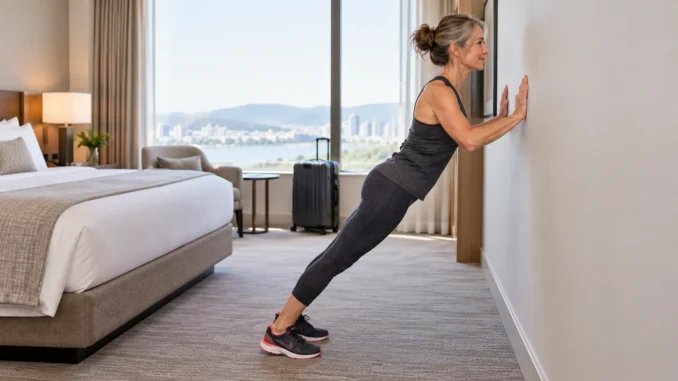
You’ve found a little time to exercise, but the hotel gym is closed and dinner is in half an hour. What’s worth doing?
A few familiar strength exercises can give you a manageable session without taking over the evening. The same approach works when you’re visiting family, attending a conference, or spending a week somewhere you’d rather be outside.
Travel changes your schedule, equipment, and energy. Give your training some room to change with it. Before you leave, decide what would fit the trip and when you’ll return to your usual routine. That takes a lot of the daily negotiation out of it.
Finding room for strength training
For a week away, you might plan two strength sessions, each around 15–20 minutes, with a day between them. Before breakfast could work; so could a quiet stretch before dinner. Have a backup in mind, then get on with the trip. An unusually busy week is a good reason to adjust your plan.
Check what equipment is actually available. If you have a resistance band you already use, it may be worth packing. Familiar band and bodyweight exercises can work well here; choose versions that suit your current strength.
If you’ve been following our full-body strength foundation for adults over 40, take familiar exercises with you. You won’t need to spend your limited time learning a whole new routine.
A simple hotel room session
Start by looking at your space. You’ll want a clear floor, a firm chair without wheels placed against a wall, and a solid wall or fixed counter for support. Skip movable furniture, towel rails, and improvised band anchors.
This is a general starting point for adults who can exercise independently. Follow any medical restrictions. If pain, recent surgery, or a health condition makes an exercise uncertain, get individual guidance before trying it.
Spend about three minutes walking or marching comfortably, moving your shoulders, and practicing a few easy chair stands and hip hinges. Then try one round of the movements below. Add a second if you have time and still feel in control.
Rest about 30–60 seconds between exercises, or longer if you need it. One set of 8–12 repetitions is a common starting point for strength work. The counts below are suggestions you can adapt; stop earlier whenever you need to.
-
Stand up from a chair, 8–12 times. Plant your feet, lean forward slightly, and stand. Sit down with control. Use your hands for help if needed. If that’s easy and squatting is familiar, try a bodyweight squat to a comfortable depth with the chair behind you.
-
Do 6–12 wall or counter push-ups. Keep your body in a straight line as you bend your elbows and press away. Start at a wall for a gentler version. A lower, fixed counter can add challenge if you can use it securely.
-
Practice 8–12 hip hinges. Soften your knees and move your hips backward, keeping your back comfortable and steady. Stand tall without leaning backward. Start without weight. If you know the movement well, hold a manageable bag close to your body.
-
Add 8–12 band rows if you have a suitable setup. Check the band for damage and follow its manufacturer’s instructions for securing it beneath both shod feet. Hinge slightly, pull toward your hips, and lower slowly. Skip this if the setup is insecure or the exercise is unfamiliar. Without pulling resistance, you’ll have a partial strength session; return to pulling exercises when your usual equipment is available.
-
Carry a light bag for 20–30 seconds per side, if practical. Use a sturdy, fixed handle and a clear, level path. Walk slowly with your shoulders level, choosing a load you can set down easily. If grip, balance, or space makes this awkward, finish with comfortable marching instead.
Aim for moderately challenging effort, around 6–7 out of 10 for this example. Keep breathing, and finish each set before you have to strain or lose control. Stop for sharp pain, dizziness, chest discomfort, or unusual breathlessness. Chest pain, fainting, or severe trouble breathing calls for urgent medical help.
Finish with a minute or two of easy walking. If you’ve run out of time after one round, leave it there. You have a trip to enjoy.
Looking after yourself between workouts
You may already be moving more than usual. Walking around a museum or exploring a neighborhood can be a good part of the day, so consider that activity when deciding how much else feels manageable.
For moderate aerobic effort, the CDC’s talk test is useful: you can talk, but singing would be difficult. Slower strolling still gives you a break from sitting. Walking and resistance exercise contribute different things, so enjoy the walking without assuming it covers every part of your strength routine.
Your energy matters, too. Sleep loss can worsen jet lag. After a late arrival or poor sleep, an easy walk or rest day may be the better choice.
Keep food practical. A familiar protein food, some produce, and enough to feel satisfied gives you a simple way to choose a meal. Eggs and fruit, a bean-and-rice bowl, or fish with potatoes and vegetables might fit. Carry water when practical and a familiar snack if meals will be far apart. Leave room to enjoy the local food, too.
A few common travel questions
What if I only have five minutes?
Choose a few familiar movements or take a short walk. It can help you stay connected to the habit, though it won’t provide the same training dose as a longer session.
Will bodyweight exercises be enough?
They may offer plenty of challenge at your current level. Experienced lifters may need more resistance for their goals. Choose variations you can control, and avoid assuming a short hotel workout matches your usual program.
Should I make up missed sessions when I get home?
Return to your next planned workout rather than cramming sessions together. If you’re tired or feel out of practice, reduce the load or number of sets and build back according to how you respond.
Having that first home workout in your calendar can make the return feel simpler. For now, choose what’s realistic, move in ways you enjoy, and leave enough energy for the people and places you came to see.
If you travel often and want help keeping a routine, contact Steadfast Strength and Mobility to discuss your schedule, equipment, and goals.
Sources
Sources checked October 13, 2026, Eastern Time.
- Centers for Disease Control and Prevention. Adult Activity: An Overview. Weekly activity framework and benefits of doing some activity.
- American College of Sports Medicine. Updated Resistance Training Guidelines. March 17, 2026. Resistance-training options and individual goals.
- Centers for Disease Control and Prevention. What Counts as Physical Activity for Adults. Strength activity, repetitions, and sets.
- Centers for Disease Control and Prevention. How to Measure Physical Activity Intensity. Aerobic talk test.
- Centers for Disease Control and Prevention. Jet Lag Disorder. CDC Yellow Book 2026; April 23, 2025. Sleep loss and individualized timing considerations.
Enjoy our strength and mobility articles?
Add Steadfast Strength and Mobility as a preferred source on Google to see more of our training advice, educational articles, and practical fitness information.
Or choose Steadfast in Google’s source preferences

Be the first to comment